Penalty amounts current as of July 2026. Fines are adjusted periodically — always confirm the latest figures on the Transport for NSW website before relying on them.
Keeping children safe while travelling in a vehicle is one of the most important responsibilities for parents and drivers. In New South Wales (NSW), child restraint laws are designed to reduce the risk of serious injury or death in the event of a crash. These regulations specify the type of child seat a child must use based on their age and outline how restraints should be installed and used.
Whether you’re a parent, grandparent, caregiver, or someone who occasionally drives with children, understanding the child seat rules in New South Wales is essential. This guide explains the current requirements, penalties, best practices, exemptions, and safety tips to help ensure every journey is as safe as possible.
Child Seat Rules in New South Wales by Age
New South Wales law sets minimum restraint requirements according to a child’s age, under Rule 266 of the Road Rules 2014 (NSW), as summarised on the Transport for NSW seatbelts and child car seat rules page.
| Age | Requirement |
|---|---|
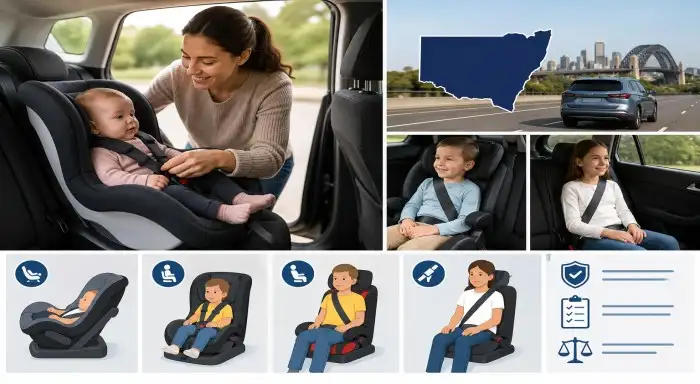
| Birth – under 6 months | Approved rearward-facing child restraint |
| 6 months – under 4 years | Rearward-facing restraint, or forward-facing restraint with inbuilt harness |
| 4 years – under 7 years | Forward-facing restraint with harness, or approved booster seat with lap-sash belt |
| 7 years and older | Booster seat, or properly fitted adult seat belt (booster often still needed until ~145–150cm tall) |
Birth to Under 6 Months
Babies from birth until six months of age must travel in an approved rearward-facing child restraint.
Rearward-facing restraints provide superior protection for a baby’s:
- Head
- Neck
- Spine
This position distributes crash forces more evenly and offers the highest level of protection for infants.
Explore More – Keeping Your Kids Safe on the Road: A Guide to Child Seat Rules in Australia
6 Months to Under 4 Years
Children aged six months to under four years must travel in either:
- A rearward-facing child restraint, or
- A forward-facing child restraint fitted with an inbuilt harness.
Although the law allows some children to move into a forward-facing seat, many child safety experts recommend keeping children rearward-facing for as long as the manufacturer’s height or weight limits permit.
4 Years to Under 7 Years
Children aged four years to under seven years must use:
- A forward-facing child restraint with an inbuilt harness, or
- An approved booster seat secured with a correctly adjusted lap-sash seat belt or child safety harness.
An adult seat belt alone is not considered suitable for children in this age group.
7 Years and Older
Children aged seven years and above may use:
- A booster seat, or
- A properly fitted adult seat belt.
However, simply reaching the age of seven does not necessarily mean a child is ready for an adult seat belt. Many children need a booster seat until they are approximately 145–150 cm tall, ensuring the seat belt fits correctly across the shoulder and hips.
It’s also worth noting that NSW’s broader seatbelt rules cover passengers up to age 16 — the driver remains legally responsible for ensuring every child and teen passenger under 16 is correctly restrained, not just those in the 0–7 age bracket covered by the child restraint rules above.
Types of Child Restraints
Choosing the correct restraint is essential for your child’s safety.
Rearward-Facing Infant Seat
Designed for newborns and young babies, these seats feature:
- A five-point harness
- Reclined seating position
- Full head and neck support
These seats offer the greatest protection during infancy.
Forward-Facing Child Seat
Suitable for older toddlers, these restraints use an integrated harness to secure the child’s shoulders and hips while offering additional side-impact protection.
Booster Seat
Booster seats raise the child so the vehicle’s seat belt fits correctly across the strongest parts of the body.
A properly fitted lap-sash belt should:
- Cross the middle of the shoulder
- Sit across the upper thighs
- Never rest on the neck or stomach
Choosing an Approved Child Restraint
Always choose a restraint that complies with the Australian/New Zealand Standard AS/NZS 1754.
When purchasing a child restraint, consider:
- Your child’s age
- Height
- Weight
- Vehicle compatibility
- Ease of installation
- Future growth
Always read both the restraint manufacturer’s instructions and your vehicle owner’s manual before installation.
Explore More – A Guide to Child Seat Rules in New Zealand
Seating Position Requirements
The rear seat is the safest place for children to travel and should always be used whenever possible. NSW child restraint laws include specific rules about where young children can sit in a vehicle to maximize their safety.
Under the child seat rules in New South Wales:
- Children under 4 years of age must not sit in the front seat of a vehicle that has two or more rows of seats. They must travel in an approved rearward-facing or forward-facing child restraint in the rear seating area.
- Children aged 4 to under 7 years may only sit in the front seat if all rear seating positions are occupied by other children under 7 years of age. Even in this situation, they must use an approved forward-facing child restraint or booster seat appropriate for their age and size.
If a child is legally permitted to travel in the front seat, ensure the restraint is suitable for that seating position, move the front passenger seat as far back as possible, and follow both the vehicle and child restraint manufacturer’s instructions.
What NSW Officials Say About Child Seat Safety
NSW government officials have repeatedly stressed that the biggest factor in child restraint safety isn’t just owning the right seat — it’s using it correctly.
When new child car seat safety ratings were released to help parents compare products, then NSW Minister for Regional Transport and Roads Paul Toole pointed out that installation is a major part of the picture, noting that “the risk of serious injuries in a crash is seven times higher” when a seat is not correctly fitted. His comments came alongside those of then Minister for Transport and Roads Andrew Constance, who said the updated ratings were introduced to help parents cut through the confusion when choosing between the many child car seats on the market.
Similarly, when the NSW Government and NRMA released a star-rating system for child car seats through the Child Restraint Evaluation Program, then Minister for Roads, Maritime and Freight Melinda Pavey framed the goal in simple terms: “every parent wants the best for their kids,” and the star system was designed to make that choice straightforward.
NSW Accident Reports and Real-World Cases
Beyond the legal penalties, official reports and real crash cases from NSW help illustrate why these rules matter in practice.
The NSW Child Death Review Team’s 10-year review. The NSW Child Death Review Team, part of the NSW Ombudsman’s office, examined the deaths of 66 children aged 0–12 who died as passengers in NSW vehicle crashes between 2007 and 2016. The review found that restraint use, or the lack of it, was a recurring factor across these cases — prompting a formal recommendation that Transport for NSW study child restraint practices more closely, particularly in areas of socio-economic disadvantage and outside major cities. That recommendation has since been implemented. In response to the review’s findings, NSW Police launched a child vehicle restraint program in western Sydney in 2019, working with Mount Druitt Police and local partners to provide free, compliant restraints along with hands-on fitting training for families.
Real cases reported in NSW courts. Restraint failures have also featured in serious criminal matters before NSW courts. In one widely reported western Sydney case, a driver faced trial after an 11-month-old baby, allegedly being held unrestrained on an adult’s lap rather than secured in a child restraint, died from injuries sustained when the vehicle crashed and made contact with the airbag and steering wheel. Cases like this illustrate what the statistics represent in practice: restraint failure is a recurring, documented factor in the most serious child passenger crash outcomes in NSW, not just a theoretical compliance issue.
Together, the official review data and real-world case reports reinforce the same conclusion covered earlier in this guide — correct, age-appropriate restraint use is one of the most effective, evidence-backed ways to protect children in a crash.
Explore More – Child Car Seat Rules in Belgium
Penalties for Not Following NSW Child Seat Laws
Drivers are legally responsible for ensuring every child passenger is correctly restrained, and NSW Police actively enforce these rules through roadside checks and seatbelt detection cameras.
| Offence | Penalty |
|---|---|
| On-the-spot fine (per child, per offence) | $423 fine + 3 demerit points |
| During double demerit periods | $423 fine + 6 demerit points |
| Maximum penalty if court-elected | Up to $2,200 |
If a driver has multiple children who are unrestrained or incorrectly restrained, the fine applies separately for each child. During long weekends and holiday periods, demerit points for this offence double — meaning a single incorrectly restrained child could cost a driver 6 points, not 3.
Beyond the financial and licence penalties, failing to properly restrain a child carries a far more serious risk. A NSW child death review study found that nearly half of child passenger deaths involve a child who was unrestrained, or restrained incorrectly or inappropriately for their age — a reminder that these rules exist to prevent real, well-documented harm, not just to generate fines.
Additional Child Passenger Safety Tips
Beyond meeting the legal requirements, parents and caregivers can improve safety by following these recommendations:
- Keep children rearward-facing for as long as possible within the restraint’s approved height and weight limits.
- Continue using an inbuilt harness until the child outgrows it.
- Delay transitioning to an adult seat belt until it fits correctly.
- Register your child restraint with the manufacturer if available to receive safety updates or recall notices.
- Replace any restraint involved in a significant collision, even if no visible damage is present.
- Regularly inspect straps, buckles, and anchor points for signs of wear or damage.
- Ensure every passenger is properly restrained before starting the vehicle.
Frequently Asked Questions
Can my child move to a booster seat before turning four?
No. New South Wales law requires children under four years of age to remain in an approved rearward-facing or forward-facing child restraint with an inbuilt harness.
Can a seven-year-old still use a booster seat?
Yes. Many children are safer in a booster seat beyond the age of seven if an adult seat belt does not fit correctly.
Are second-hand child seats safe?
They can be, provided they meet Australian safety standards, have never been involved in a serious crash, are not expired, and include all original parts and instructions.
Do I need a child seat for short trips?
Yes. NSW child restraint laws apply regardless of the distance travelled. Even short journeys can involve collisions, making proper restraints essential every time.
What’s the fine for breaking child car seat rules in NSW?
As of July 2026, the on-the-spot fine is $423 and 3 demerit points per child, per offence, doubling to 6 demerit points during double demerit periods. Courts can impose fines of up to $2,200 for serious or contested cases. Always check the Transport for NSW website for the current figure, as fines are adjusted periodically.
Final Thoughts
Understanding and following the child seat rules in New South Wales helps ensure children travel safely at every stage of development. Using the correct restraint for a child’s age, height, and weight, installing it properly, and ensuring the harness is correctly adjusted can dramatically reduce the risk of injury in a crash.
While NSW law establishes the minimum legal requirements, choosing the safest option — such as keeping children in rearward-facing restraints or booster seats for as long as they fit — can provide even greater protection. By staying informed, using approved child restraints, and following best-practice safety recommendations, parents and caregivers can help make every journey safer and more secure for their youngest passengers.