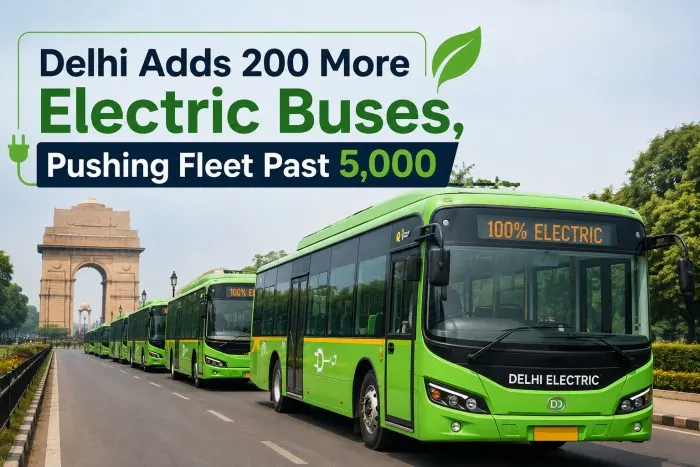
Delhi has expanded its electric bus network with another 200 vehicles, moving the capital’s zero-emission fleet beyond the 5,000-unit mark as the city works toward a much larger transit overhaul. Chief Minister Rekha Gupta, Transport Minister Pankaj Kumar Singh and Lieutenant Governor Taranjit Singh Sandhu flagged off the new buses last week, with the rollout weighted heavily toward improving access in neighborhoods that have historically been underserved by the city’s main transit corridors.
A Fleet Built for Narrow Streets and Women Riders
Of the 200 buses added, 112 are nine-metre vehicles and 88 are twelve-metre vehicles, and the split reflects two different transit problems the city is trying to solve at once. The smaller nine-metre buses belong to Delhi’s DEVi (Delhi Electric Vehicle Interconnector) program, built specifically to weave through narrow, congested residential lanes and feed passengers into the city’s larger bus corridors and metro stations — the kind of last-mile connectivity gap that often keeps people from using public transit at all.
These smaller buses appear to be PMI Electro Mobility Solutions’ Regio model, and if this batch matches earlier DEVi deployments, they’re likely running the 23-seat configuration with room for 13 standing passengers and a range beyond 200 kilometres. The twelve-metre buses, meanwhile, appear to be JBM Auto’s Eco-Life 12dl, typically used on higher-capacity trunk routes.
A significant share of the new fleet is also going toward women-focused service. Delhi is running 56 women-only bus services across 28 routes as part of this deployment, including 30 “Ladies Special” trips on 15 high-demand routes and 26 “University Ladies Special” trips on 13 routes specifically serving female students commuting to college.
Charging Infrastructure and a New Interstate Route
Alongside the bus rollout, the city opened a public EV charging station at Rajghat Depot-1, adding to the charging backbone needed to keep an electric fleet of this size running reliably. Delhi also launched a new interstate electric bus service connecting the capital to Karnal in neighboring Haryana, roughly 120 kilometres north — a sign the city’s electrification push is starting to extend beyond purely municipal routes.
The Road to 14,000 Buses
This latest addition is one step in a much larger plan. According to state transport data available through India’s national transport information portal, Parivahan, Delhi is targeting a total bus fleet of 7,500 vehicles by March 2027, of which 5,800 would be electric. Officials have laid out an even more ambitious longer-term goal: growing the citywide fleet to around 14,000 buses by the 2028-29 financial year.
If Delhi hits those targets, it would represent one of the largest municipal electric bus transitions anywhere in the world — a scale-up driven as much by air-quality pressure in one of the world’s most polluted capitals as by the practical need to move a fast-growing population through increasingly congested streets.