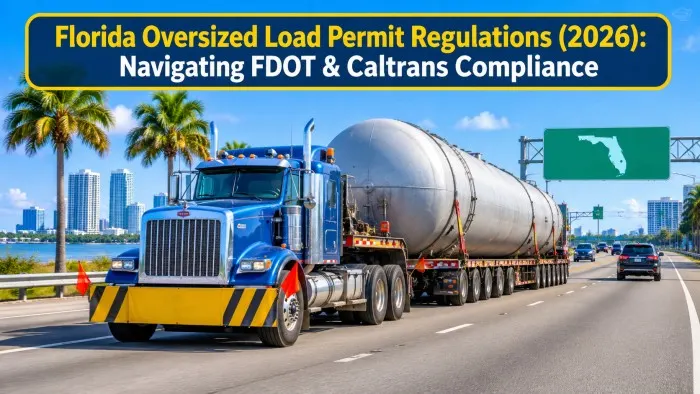
Moving super-loads, heavy construction machinery, or modular infrastructure across state lines requires strict adherence to state-level transportation departments. A frequent point of confusion for dispatchers and owner-operators planning coast-to-coast hauls is mixing up jurisdictional frameworks—specifically, trying to apply Caltrans (California Department of Transportation) rules to Florida routes.
Caltrans governs California’s state highway network, whereas oversized and overweight (OS/OW) freight in the Sunshine State is regulated exclusively by the Florida Department of Transportation (FDOT) and enforced by the Florida Highway Patrol (FHP) Commercial Vehicle Enforcement unit.
For carriers operating between the Southeast and the West Coast—or logistics teams managing multi-state compliance—understanding Florida’s 2026 permitting rules, violation penalties, and how they diverge from Caltrans standards prevents costly roadside detentions, permit revocations, and route delays.
Legal Dimensions vs. Oversize Thresholds in Florida
Before applying for a permit through FDOT’s online portal, carriers must measure the exact loaded dimensions of the power unit, trailer, and cargo. Under Florida Statutes Chapter 316, any non-divisible load exceeding standard legal limits requires an Over-Weight/Over-Dimensional (OWOD) permit prior to entering Florida state highways.
| Dimension / Metric | Florida Standard Legal Limit | Florida Routine Permit Threshold |
|---|---|---|
| Width | 8 feet 6 inches (8′ on select non-designated roads) | Up to 14 feet (16 feet max via automated self-issue) |
| Height | 13 feet 6 inches (14′ for auto transporters) | Up to 14 feet 6 inches (18 feet max via self-issue) |
| Length (Overall) | 75 feet (48′ trailer; 53′ with 41′ kingpin setting) | Up to 95 feet (150 feet max via self-issue) |
| Overhang | 3 feet front / 3 feet rear | Up to 10 feet rear (night travel restricted) |
| Gross Weight | 80,000 lbs | Up to 142,000 lbs (7 axles) / 200,000 lbs self-issue limit |
Note: Loads exceeding 16 feet wide, 18 feet high, 150 feet long, or 200,000 pounds are classified as Super Loads and require manual engineering review, bridge analysis, and route surveys before FDOT grants clearance.
Explore More- California Oversized Load Permit Regulations (2026): Navigating Caltrans Compliance
How to Apply for a Florida OS/OW Permit in 2026
FDOT streamlines routine permitting through its automated FDOT Permit Application System (PAS), allowing motor carriers to self-issue single-trip permits without waiting for manual office review—provided the load stays within automated GIS routing thresholds.
1. Permit Types and Validity
- Single-Trip Permits: Valid for 5 consecutive days for non-divisible loads (or up to 10 days for eligible off-interstate divisible load permits). Electronic copies on a cab tablet or printed hardcopies are accepted at FHP weigh stations. FDOT
- Blanket Permits: Valid for 12 months for carriers making repeated moves within standardized dimensions (typically up to 12 feet wide, 14 feet 6 inches high, and 85 feet long). Standard transferable blanket permits require carrying the original document in the cab, whereas VIN-specific blanket permits may be carried electronically.
2. Travel Curfews, Escorts, and Safety Gear
- Operating Hours: Routine oversize travel is permitted from 30 minutes before sunrise until 30 minutes after sunset, Monday through Friday. Weekend travel is restricted to 30 minutes before sunrise until 12:00 noon on Saturday and Sunday (loads 10 feet wide or under at legal height and length may run full daytime hours).
- Holiday Blackouts: Movement is prohibited on six major national holidays, Martin Luther King Jr. Day, and often the days immediately preceding and following New Year’s Day, Thanksgiving, and Christmas.
- Pilot Cars (Escorts): One certified escort vehicle is required when width exceeds 12 feet (on two-lane roads) or 14 feet (on multi-lane highways), or when overall length exceeds 95 feet. Loads over 150 feet long or exceeding 15 feet in height require two pilot cars and a documented route survey.
- Signage & Lighting: Standard “OVERSIZE LOAD” banners (7 feet wide by 18 inches high with black lettering on a yellow background) and 18-inch red/fluorescent orange flags at all extremities are mandatory. Loads exceeding 12 feet wide, 14 feet 6 inches high, or 85 feet long must also display two 360-degree amber warning beacons (one on the tractor, one at the rear of the load).
Florida OS/OW Permit Violations, Fines, and Nullification Rules
Under Florida Administrative Code Rule 14-26.015 and Florida Statutes Section 316.550, the Florida Highway Patrol enforces strict penalties for operating without a permit or breaching permit stipulations. Any vehicle found in violation is placed out of service at the roadside until the carrier corrects the irregularity, offloads excess weight, or obtains a valid permit matching actual load dimensions.
Financial Penalties & Fines
- Operating Oversize Without a Permit: Up to $1,000 per violation. Florida Highway Safety and Motor Vehicles (.gov)
- Overweight Violations (Statutory & Permitted): $10 for excess weight of 200 pounds or less; $0.05 per pound for every pound exceeding 200 pounds over the legal or permitted limit (with no upper cap on gross-weight fines). Vehicles exceeding maximum allowable gross weight by more than 6,000 pounds must unload the excess cargo at the roadside before proceeding. Oversize.io+ 1
- Dimensional & Safety Stipulation Breaches: Cumulative penalties up to $1,000 for exceeding permitted width, height, or length, or failing to meet escort, banner, flag, and lighting rules. Statutes & Constitution :View Statutes : Online Sunshine
- Curfew & Weigh Station Violations: Operating during prohibited weekend, holiday, or nighttime hours—or bypassing an open FHP weigh station—carries a $1,000 penalty and mandatory roadside detention until the next authorized travel window.
Explore More- Massachusetts Oversized Load Permit Regulations (2026)
Actions That Render a Permit Null and Void
Even if a carrier holds a valid FDOT permit, FHP officers will treat the vehicle as completely unpermitted—assessing full statutory fines for both size and weight from the legal baseline—if the driver commits any of the following violations:
- Route Deviation: Traveling off the exact highway route designated on the permit sheet.
- Misrepresented Load or Equipment: Operating with fewer axles, a shorter outer-bridge wheelbase, or smaller tires than listed on the permit application.
- Altered, Forged, or Expired Permits: Presenting an expired document, a photocopy of a non-VIN blanket permit, or an altered permit. Justia Regulations
- Unauthorized Multiple Loading: Hauling multiple items that compound over-dimensional or overweight limits when only a single non-divisible item was permitted. FDOT
Repeated non-compliance, unpaid penalties, or falsified permit applications give FDOT grounds to suspend or revoke a carrier’s active multi-trip permits and block future PAS self-issue privileges.
Florida (FDOT) vs. California (Caltrans): Key Compliance Differences
If your fleet regularly hauls freight between Florida and California, assuming one state’s permit rules mirror the other is a fast track to a citation. While both states adhere to federal interstate baselines, their operational rules diverge sharply:
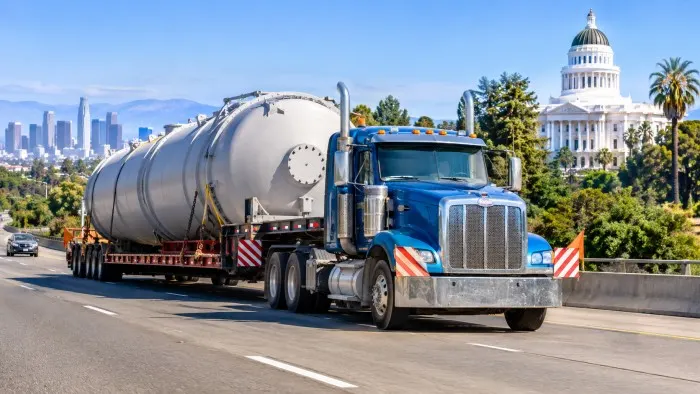
- Standard Legal Height: California allows a legal height of 14 feet on most state highways, whereas Florida caps standard legal height at 13 feet 6 inches. A 13’10” load that runs legally without a permit in California becomes an illegal over-height violation the moment it crosses into Florida without an FDOT permit.
- Color-Coded Route Networks vs. GIS Self-Issue: Under the Caltrans Transportation Permits Manual, California classifies state highways using color-coded route maps (Yellow, Green, Blue, Brown, and Red routes) that dictate 24/7 travel eligibility, pilot car thresholds, and strict metropolitan rush-hour curfews in Los Angeles, San Francisco, San Diego, and Sacramento. Florida relies instead on dynamic GIS bridge-clearance mapping inside PAS and enforces uniform statewide weekend noon cutoffs rather than color-coded highway tiers.
- Kingpin-to-Rear-Axle (KPRA) Rules: California strictly enforces a 40-foot KPRA limit on 53-foot trailers (measured from the kingpin to the center of the rear axle), while Florida permits a 41-foot kingpin setting on 53-foot semi-trailers under standard legal dimensions.
- Turnpike & Local Jurisdiction Rules: Florida’s Turnpike restricts routine oversize loads to 12 feet wide and 13 feet 6 inches high and requires separate per-mile toll authorization during the state permit application. Furthermore, neither FDOT nor Caltrans permits cover county roads or municipal streets—carriers must secure local city or county permits separately when leaving state-maintained corridors.
Explore More- California Electric Scooter and E-Bike Helmet Laws: A Legal, Safety, and Enforcement Guide
Best Practices for Multi-State Heavy Haul Compliance
- Verify Axle Spacings Before Dispatch: Both FDOT and Caltrans calculate allowable bridge weights using axle-group spacing formulas rather than gross weight alone. Record exact center-to-center axle measurements and tire widths before submitting permit applications.
- Audit Route Restrictions Ahead of Border Crossings: Never rely on consumer GPS navigation for OS/OW freight. Cross-check every mile against the specific route listed on your FDOT permit sheet—deviating from the approved corridor immediately voids permit coverage and exposes the carrier to full statutory overweight/over-dimension fines.
- Carry Current Insurance & Registration Certificates: Both states require active proof of commercial auto liability coverage (minimum $750,000 for standard oversize moves, scaling up to $5 million for super-loads) and valid IRP/IFTA credentials matching the permitted power unit (Florida additionally requires commercial vehicles hauling OS/OW loads to carry a valid 80,000-pound restricted registration tag).