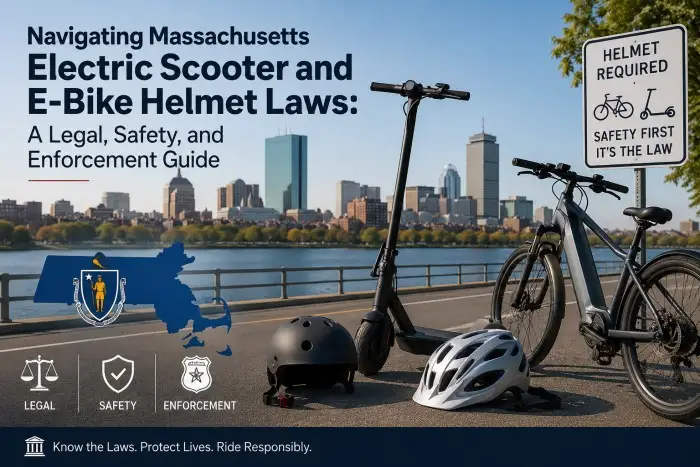
The rapid expansion of micro-mobility – electric scooters (e-scooters) and electric bicycles (e-bikes) – has reshaped urban transport across the Commonwealth of Massachusetts. However, operating these devices legally requires navigating a complex patch of Massachusetts General Laws (MGL).
Regulatory distinctions between device classifications dictate whether a rider is legally required to wear a protective helmet, what certification standard that helmet must meet, what statutory fines exist for violations, and how liability is evaluated after a collision.
The Legal Classification Framework
Under Massachusetts law, rules governing protective headgear depend heavily on how your device is legally categorized:
| Micromobility Classification | Key Specifications | Helmet Requirement |
|---|---|---|
| Class 1 & 2 E-Bikes |
750W maximum power Maximum speed: 20 mph MGL c. 85 §113B |
Ages ≤16 CPSC standard |
| Motorized Scooters | MGL c. 90 §1E |
Everyone Safety standard |
|
Motorized Bicycles Including Class 3 E-Bikes |
MGL c. 90 §1B |
Everyone DOT standard |
1. Electric Bicycle (E-Bike) Helmet Laws
Massachusetts formally codified electric bicycle definitions under MGL Chapter 85, Section 11B¾.
The Two-Class Recognized Framework
Massachusetts state law officially recognizes Class 1 and Class 2 electric bicycles:
- Class 1: Pedal-assist only, motor stops assisting at 20 mph.
- Class 2: Throttle-assisted, motor stops assisting at 20 mph.
Helmet Requirements for Class 1 and Class 2 E-Bikes
- Riders 16 Years of Age or Younger: Mandatory. Under MGL c. 85 §11B½, any person 16 years of age or younger operating or riding as a passenger on a Class 1 or Class 2 e-bike must wear an approved protective helmet.
- Riders 17 Years of Age and Older: State law does not require adult riders of Class 1 or Class 2 e-bikes to wear a helmet.
- Helmet Certification Standards: Required youth helmets must conform to the safety standards established by the United States Consumer Product Safety Commission (16 CFR Part 1203).
The Class 3 E-Bike Exception
Massachusetts does not classify 28-mph pedal-assist (Class 3) e-bikes under the standard bicycle statutory framework. Any electric bicycle exceeding 20 mph or 750 watts defaults to a “Motorized Bicycle” (moped) under MGL c. 90 §1B.
- Helmet Requirement: Mandatory for ALL riders and passengers regardless of age.
- Certification Standard: Must wear a helmet approved by the Department of Transportation (DOT Standard).
2. Electric Scooter (Motorized Scooter) Helmet Laws
Motorized e-scooters fall under distinct statutory provisions under MGL Chapter 90, Section 1E.
| Requirement | Details |
|---|---|
| Primary Statute | MGL Chapter 90, Section 1E |
| Helmet Requirement | Universal — All Operators and Passengers |
| Minimum Operator Age | 16 Years Old |
| Speed Limit | 20 mph Maximum Operating Speed |
| Licensing | Driver’s License or Learner’s Permit Required |
Statutory Helmet Mandates for E-Scooters
Unlike standard bicycles or Class 1 e-bikes, all electric scooter operators and passengers must wear protective headgear, regardless of age.
- Universal Requirement: Under MGL c. 90 §1E, no person may operate or ride as a passenger on a motorized scooter without wearing a helmet.
- Standard Requirements: Helmets must meet state safety standards, typically requiring a CPSC-compliant bicycle helmet or a DOT-compliant helmet, properly fitted and secured with chinstraps.
- Driver Licensing & Operational Limits: Operators must hold a valid driver’s license or learner’s permit. Scooters cannot carry passengers or be operated after sunset or before sunrise.
3. Fines, Enforcement, and Statutory Violations
Massachusetts law establishes specific statutory fines and police powers for micro-mobility infractions across different classifications:
| Device Type | Primary Citation Rule | Penalty / Fine Schedule |
|---|---|---|
| Class 1 & 2 E-Bikes | MGL c. 85 §11B / §11E | Up to $20 fine per offense |
| Motorized Scooters | MGL c. 90 §1E | Standard traffic fines |
| Motorized Bicycles (Class 3 E-Bikes) |
MGL c. 90 §1B | 1st Offense: Up to $25 |
| 2nd Offense: $25 – $50 | ||
| Subsequent: $50 – $100 |
Statutory Penalties Detailed
- E-Bike Fines (MGL c. 85 §11B & §11E): Traffic law violations (including illegal sidewalk riding) are punishable by a fine of up to $20.
- Impoundment of Minor Equipment: Under MGL c. 85 §11E, if a minor under 18 commits a traffic violation, local law enforcement officers may impound the bicycle or e-bike for up to 15 days.
- Failure to Identify: Under MGL c. 85 §11E, an officer observing a violation may request the rider’s name and address. Refusing to provide identity or providing false information is punishable by a fine of $20 to $50 and allows arrest without a warrant.
- Motorized Bicycle / Class 3 Fines (MGL c. 90 §1B): Operating a Class 3 or moped-classified device without a helmet, exceeding 25 mph, or riding without a valid license triggers tiered criminal/civil fines: up to $25 for a first offense, $25 to $50 for a second offense, and $50 to $100 for subsequent offenses.
Statutory Comparison Matrix
| Device Category | Statutory Definition | Helmet Requirement | Statutory Fine for Violations |
Helmet Certification Standard |
|---|---|---|---|---|
| Class 1 E-Bike (≤20 mph, pedal-assist) | MGL c. 85 §11B¾ | Required for ages ≤16 | Up to $20 | CPSC (16 C.F.R. Part 1203) |
| Class 2 E-Bike (≤20 mph, throttle) | MGL c. 85 §11B¾ | Required for ages ≤16 | Up to $20 | CPSC (16 C.F.R. Part 1203) |
| Class 3 / High-Power E-Bike (>20 mph or >750W) | MGL c. 90 §1B | Mandatory for ALL riders | $25 – $100 (Tiered) | U.S. DOT Compliant |
| Motorized E-Scooter | MGL c. 90 §1E | Mandatory for ALL riders | Civil traffic citation | CPSC / State Approved |
Local Municipalities vs. State Preemption
While Massachusetts General Law sets baseline requirements, municipal authorities maintain local regulatory oversight over micro-mobility:
- Sidewalk Restrictions: Statewide law under MGL c. 85 §11B¾ explicitly bans e-bikes and e-scooters from being operated on sidewalks.
- Shared Bike/Scooter Programs: Commercial share programs strictly require users to agree to state helmet regulations during app registration.
- Park & Trail Bans: The Department of Conservation and Recreation (DCR) restricts e-bikes on unpaved trails; Class 1 e-bikes are generally allowed on paved multi-use paths (such as the Minuteman Bikeway or Cape Cod Rail Trail), whereas throttle-equipped Class 2 e-bikes or high-speed e-scooters may face local access restrictions.
Liability and Legal Consequences of Helmet Violations
If an unhelmeted rider is involved in a traffic collision, statutory protections and comparative negligence rules come into play under MGL Chapter 231, Section 85:
1. Statutory Protections for Minors (MGL c. 85 §11B)
Massachusetts law includes explicit protections for young riders:
- Under MGL c. 85 §11B, a minor’s failure to wear a helmet cannot be used as evidence of contributory negligence in a civil action to deny or reduce damages.
- A violation of Section 11B by a minor under 18 does not affect any civil right or liability.
2. Adult Comparative Negligence (MGL c. 231 §85)
For adult operators, Massachusetts follows a modified comparative negligence framework with a 51% bar:
- If an adult rider violates a mandatory helmet law (such as operating an e-scooter unhelmeted under Section 1E), insurance carriers may introduce this statutory violation as evidence of comparative fault for head injuries.
- If a plaintiff’s share of fault for their injuries is determined to be greater than 50%, they are barred from recovering financial compensation.