
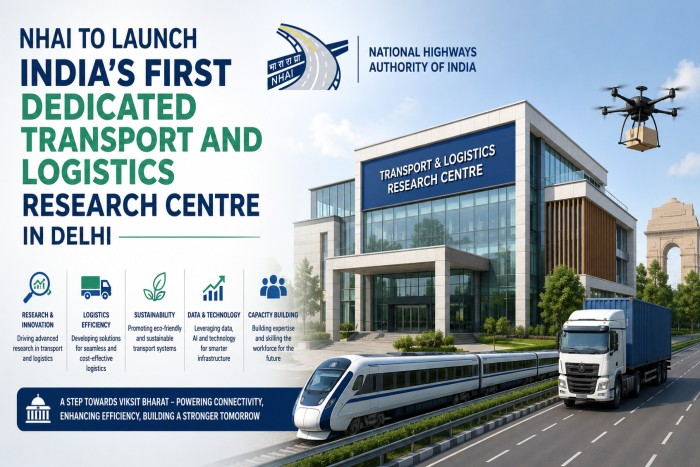
In a significant step toward strengthening India’s transportation ecosystem, the National Highways Authority of India (NHAI) has announced the establishment of the country’s first dedicated research centre focused on transportation, mobility, and logistics economics. The centre will be set up in collaboration with the National Council of Applied Economic Research (NCAER) in New Delhi and is expected to serve as a key hub for data-driven policy research and strategic planning.
A Major Push for Evidence-Based Infrastructure Planning
As India’s highway network, freight movement, and logistics sector continue to expand rapidly, policymakers are increasingly relying on research-backed insights to guide future investments. The new centre aims to bridge the gap between infrastructure development and economic analysis by producing actionable research that supports long-term transportation planning.
According to official announcements, NHAI has signed a Memorandum of Understanding (MoU) with NCAER to establish the research facility. The initiative reflects a growing emphasis on integrating data analytics, economic modelling, and evidence-based decision-making into the country’s transportation strategy.
What Will the Research Centre Focus On?
The centre will undertake applied research across multiple areas that influence India’s transport and logistics landscape. Key focus areas include:
- National highway economics
- Freight transportation and logistics efficiency
- Multi-modal transport integration
- Regional economic impact assessments
- Tolling policies and user pricing models
- Asset monetization strategies
- Road safety interventions
- Technology adoption in highway operations and maintenance
The findings generated through these studies are expected to help government agencies improve policy formulation, infrastructure investment decisions, and operational efficiency across the transport sector.

Why This Initiative Matters
India’s logistics sector plays a critical role in economic growth, manufacturing competitiveness, and supply chain efficiency. However, transportation planning often requires reliable data, economic forecasting, and long-term policy evaluation.
The new research centre is designed to address these needs by providing policymakers with robust analytical support. By studying freight movement patterns, infrastructure utilization, and economic impacts, the institution can help identify opportunities to reduce logistics costs, improve connectivity, and enhance the overall efficiency of transport networks.
Experts believe that stronger research capabilities could also contribute to better project prioritization and more effective allocation of public resources.
Supporting India’s Growing Infrastructure Ambitions
The launch of this centre comes at a time when India is investing heavily in highways, logistics parks, freight corridors, and integrated transportation networks. Several large-scale initiatives are underway to improve connectivity, reduce congestion, and strengthen supply chains across the country.
With transportation infrastructure becoming increasingly complex, policymakers require deeper insights into how investments affect economic development, trade flows, and regional growth. The new centre is expected to provide this analytical foundation, helping decision-makers evaluate the long-term impact of infrastructure projects.
A Knowledge Hub for the Industry
Beyond conducting research, the centre will function as a platform for knowledge sharing and professional development. It plans to publish policy briefs, research papers, reports, and analytical studies while also organizing workshops, consultations, and academic engagements.
This approach could foster greater collaboration among government agencies, researchers, industry stakeholders, and academic institutions, creating a stronger ecosystem for transportation research in India.
Looking Ahead
The establishment of India’s first dedicated transport and logistics research centre marks an important milestone in the evolution of the country’s infrastructure planning framework. By combining economic research, data analytics, and policy expertise, the initiative has the potential to improve decision-making across the transportation sector and support India’s long-term development goals.
As India continues to expand its highway network and modernize its logistics infrastructure, the insights generated by this new institution could play a crucial role in shaping smarter, more efficient, and more sustainable transportation systems for the future.
