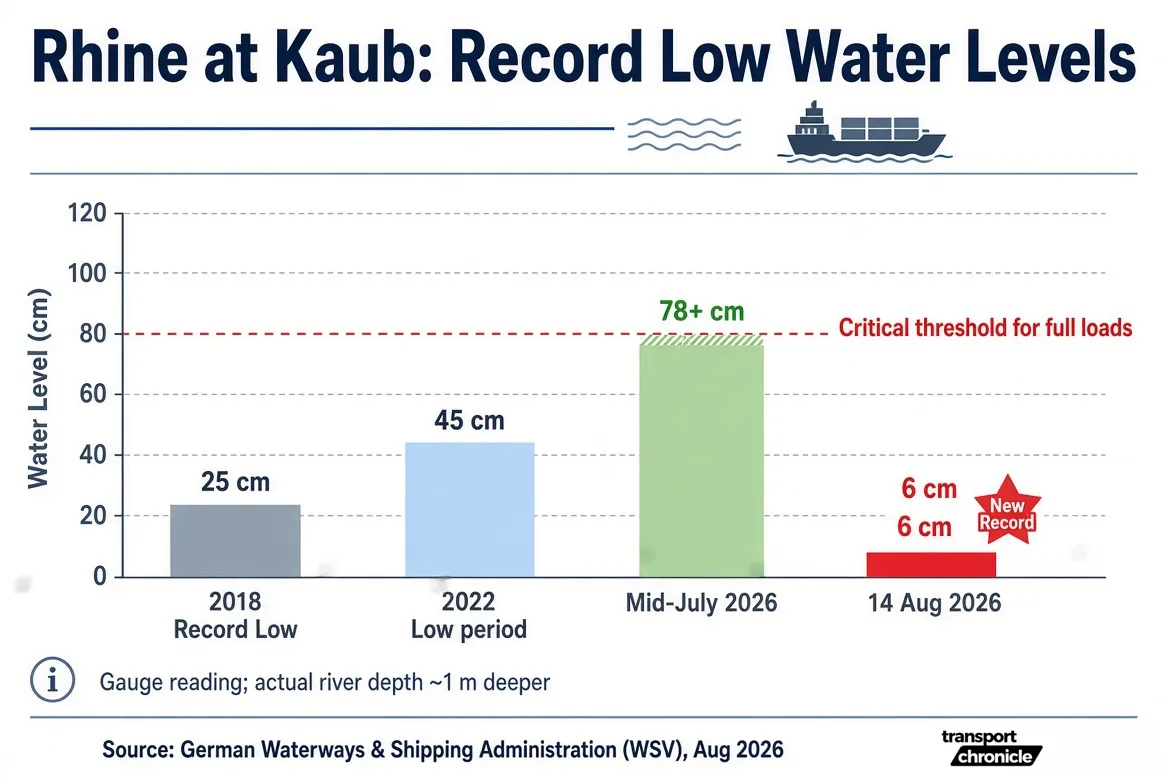
FRANKFURT — Europe’s most vital inland waterway has hit depths not seen in living memory. At the critical Kaub gauge near Koblenz, the official water level gauge fell to just 6 centimetres late on Friday 14 August 2026 and stood at 8 cm early on Saturday, according to data from Germany’s Waterways and Shipping Administration (WSV). That reading smashed the previous all-time low of 25 cm recorded in 2018 and left the navigable channel so shallow that most commercial shipping has effectively ground to a halt.
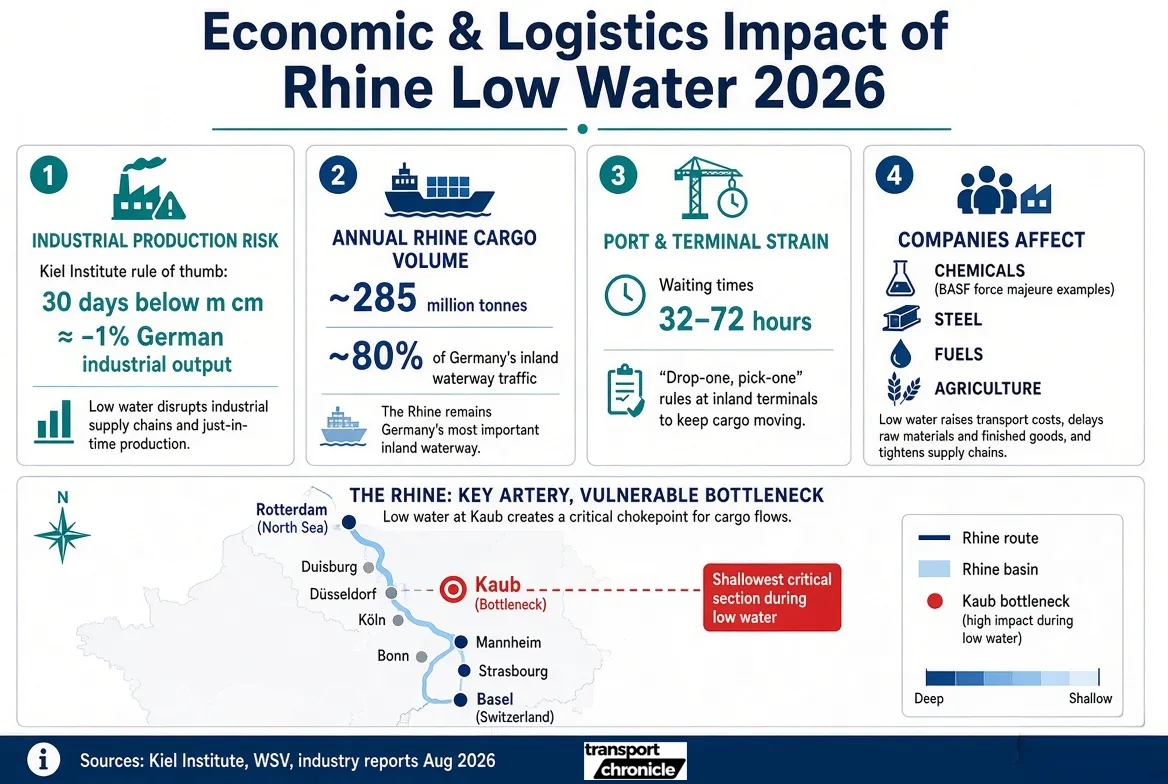
The Rhine is not merely low — it is functionally severed at its narrowest bottleneck. The river itself is roughly one metre deeper than the gauge reading, yet that still leaves insufficient depth for fully loaded barges. Levels at Kaub had last sat above the critical 78 cm threshold in mid-July. As a long-standing rule of thumb from the Kiel Institute for the World Economy, 30 consecutive days below that mark typically shaves about 1% off German industrial production — a threshold already crossed in both 2018 and 2022.
A Transport Artery Cut in Two – Economic and Logistic Impact
The Rhine normally carries around 285 million tonnes of goods a year and accounts for roughly 80% of Germany’s inland waterway traffic. Chemicals, refined fuels, coal, ores, steel inputs and agricultural commodities move between the deep-sea ports of Rotterdam, Amsterdam and Antwerp and the industrial heartlands of western and southern Germany, Switzerland and beyond.
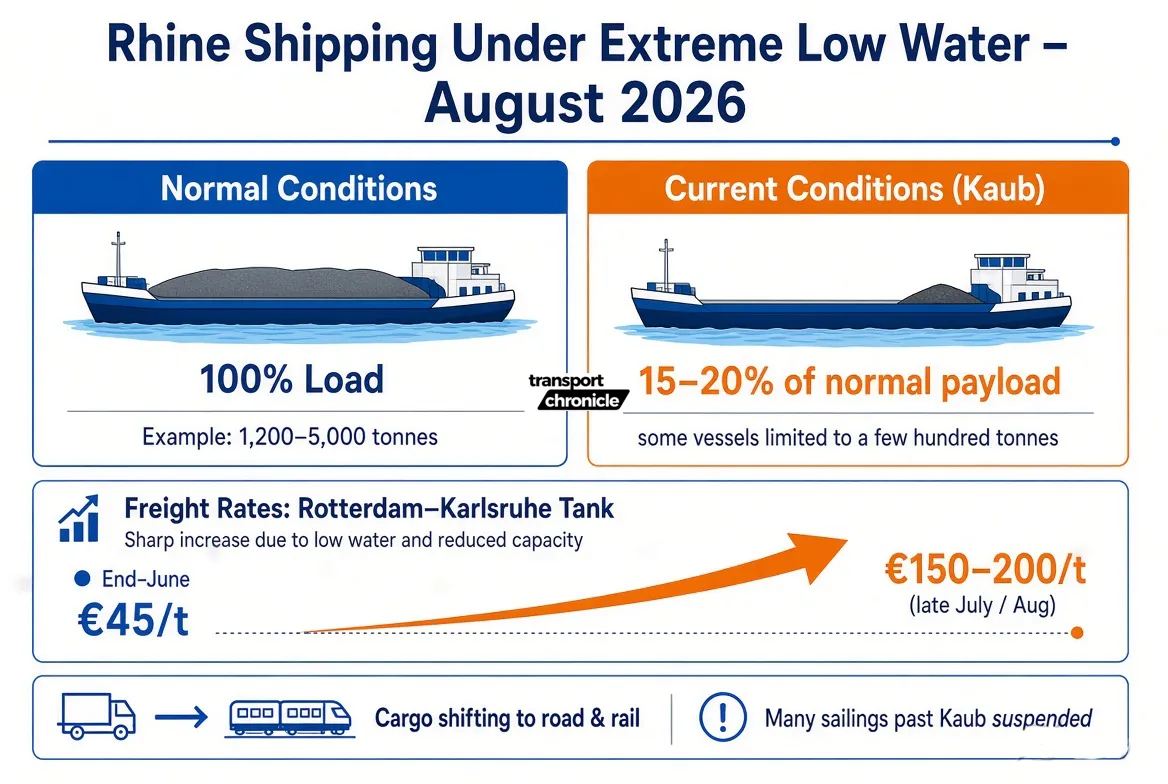
With water so low, many operators have simply stopped sailing past Kaub. Those still operating are running at 15–20% of normal payload — or less. A tanker barge that might carry 1,200 tonnes under normal conditions is now limited to a few hundred tonnes; some vessels that can handle 5,000 tonnes have been reduced to around 1,200 tonnes. The result is a sharp rise in the number of trips required and a surge in freight rates. Rotterdam-to-Karlsruhe tanker rates climbed from about €45 per tonne at the end of June to €150–155 by late July, with some reports of €200 per tonne.
Cargo is being diverted en masse to trucks and trains. Logistics group Contargo reported extra rail services, additional trucking capacity and greater use of Lower Rhine terminals as temporary hubs. Container terminals at the ARA ports are already congested; inland terminals have resorted to “drop-one, pick-one” rules to manage yard space. Waiting times of 32–44 hours for deep-sea vessels and up to 72 hours for barges have been reported.
Industry Feels the Squeeze
Chemical producers, steelmakers, utilities and agricultural traders have all flagged higher costs, bottlenecks and reduced output. BASF has declared force majeure on certain surfactants due to raw-material shortages linked to the disruption. In Duisburg, Europe’s largest inland port, operators are transferring cargo from large barges onto smaller vessels, rail or road. Markus Bangen, chief executive of the Duisburg harbour authority, described the situation as “working at our limit.”
Economists warn the timing is particularly unwelcome. Germany’s industrial sector has already been under pressure from high energy costs and global competition. The Kiel Institute estimates the current disruption could shave 0.1–0.2% off third-quarter growth through higher transport costs and constrained supply chains. A prolonged spell risks repeating — or exceeding — the economic hit of 2018.
Record Low Across Multiple Gauges
The problem is not confined to Kaub. Earlier in August, Cologne recorded levels as low as 60–67 cm, below the previous historic low of 69 cm set in 2018 (records there stretch back to 1816). Düsseldorf fell to 15 cm; Duisburg-Ruhrort dropped below its prior record of 148 cm. At the Dutch border near Lobith, levels earlier reached all-time lows around 6.47 m above NAP. Receding waters have even exposed World War II ordnance near Cologne, requiring specialist disposal.
Forecasters see little near-term relief. Another heatwave has baked the region, and significant sustained rainfall would be needed to restore navigable depths. Conditions are expected to remain difficult well into the autumn — the period when the Rhine traditionally reaches its seasonal low.
Climate Context and Structural Risk
This is the third major low-water episode on the Rhine in eight years (2018, 2022 and now 2026), each arriving earlier and, in this case, more severely. Climate scientists link the pattern to prolonged droughts and higher temperatures that increase evaporation while reducing Alpine snowmelt and summer rainfall. The river’s role as Europe’s industrial backbone means such events now carry systemic economic risk rather than isolated logistics headaches.
Operators are adapting where they can — deploying low-draft vessels, splitting cargoes and shifting modes — but the capacity of road and rail networks is finite, and both are already under strain. Until substantial rain arrives, Europe’s most important inland trade route will remain constrained, with costs and delays cascading through supply chains from the North Sea ports to the Swiss border and beyond.
Reporting based on WSV gauge data, Kiel Institute analysis, industry statements and contemporaneous coverage from Reuters, Bloomberg, dpa and other outlets.