
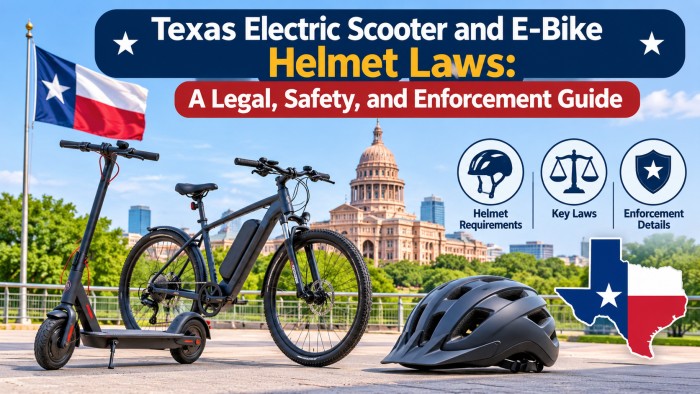
As micromobility options grow in popularity across Lone Star State urban centers, commuting by electric scooter (e-scooter) and electric bicycle (e-bike) has become standard for thousands of residents and visitors. However, navigating the legal framework governing these devices can be confusing. Texas state law establishes base classifications for e-bikes and motor-assisted scooters, but leaves helmet mandates, sidewalk bans, and enforcement penalties largely up to individual municipalities and rental operators.
Understanding the intersection of state statutes, local city ordinances, legal violations, fine structures, safety standards, and civil liability is crucial for every rider in Texas.
1. Texas Statewide Legal Framework: E-Bikes vs. E-Scooters
Texas regulates micromobility primarily through state statutory codes. Under state law, adults are not subject to a universal, statewide helmet mandate for traditional bicycles, e-bikes, or e-scooters. However, statutory operational distinctions determine how, where, and by whom these vehicles may be legally used.
Electric Bicycles (E-Bikes)
Governed under the Texas Transportation Code Chapter 664, an electric bicycle is defined as a vehicle equipped with fully operable pedals, an electric motor of 750 watts or less, and a top assisted speed of 28 mph or less. Texas recognizes three distinct classes:
- Class 1: Pedal-assist only; motor disengages when reaching 20 mph.
- Class 2: Throttle-assisted or pedal-assist; motor disengages when reaching 20 mph.
- Class 3: Pedal-assist only; motor disengages when reaching 28 mph. Must be equipped with an operational speedometer.
Age Restriction & State Violations: Under TTC § 551.107(c), operators of Class 3 e-bikes must be at least 15 years of age. Riding a Class 3 e-bike under age 15 or operating a Class 3 e-bike without a functional speedometer constitutes a state traffic violation.
Electric Scooters (Motor-Assisted Scooters)
Governed under Texas Transportation Code Chapter 551 Subchapter E, a motor-assisted scooter is defined as a self-propelled device with at least two wheels, a gas or electric motor up to 40 horsepower (or equivalent electric rating), and the ability to be propelled by human power alone.
- E-scooters are legally permitted on roads with posted speed limits of 35 mph or lower.
- No driver’s license, state vehicle registration, or liability insurance is required by Texas state law to operate standard e-scooters or e-bikes.
2. Municipal Helmet Laws, Rules, and Local Fine Structures
Because state statutes do not impose an adult helmet mandate, regulatory authority passes to home-rule municipalities. Consequently, helmet laws, sidewalk restrictions, and financial penalties vary by city.
| Texas Jurisdiction | E-Scooter / E-Bike Helmet Mandate | Sidewalk & Special Restrictions | Violation Fine Schedule |
|---|---|---|---|
| Austin | Mandatory for riders under 18 | Prohibited on sidewalks within designated downtown business zones. | Standard traffic infraction: $100 to $200 per offense. |
| Dallas | Mandatory for riders under 17 | Prohibited on sidewalks in Central Business District, Deep Ellum, and The Cedars. Max 10–15 mph speed limits in designated slow zones. | Class C Misdemeanor ticket: $50 to $200 fine. |
| Houston | Mandatory for riders under 18 | Citywide ban on sidewalk riding for e-scooters. Mandatory 8 p.m. to 4 a.m. micromobility curfew. | Fines up to $500 per violation; $100 impound fee for confiscated devices. |
| San Antonio | Mandatory for riders under 18 | Prohibited on Riverwalk, Alamo Plaza, and tourist pedestrian walkways. | City ordinance citation: Up to $500 fine. |
| Colleyville / Suburbs | Mandatory for riders under 16 | Parents strictly liable for knowingly permitting minors to ride unhelmeted. | 1st Offense: Up to $50 (dismissed if helmet purchased in 10 days). 2nd+ Offense: Up to $100–$200 + impoundment. |
Legal Note on Parental Liability & Municipal Violations
In most Texas cities with minor helmet mandates (such as Houston, Trophy Club, and Colleyville), parents or legal guardians who knowingly permit a minor to ride without a helmet are independently subject to prosecution and municipal court fines.
Contractual Violations vs. Civil Fines
Riding a shared rental e-scooter or e-bike (e.g., Lime or Bird) unhelmeted in a city without an adult helmet law will not result in a police ticket, but it constitutes a breach of the operator’s Terms of Service Agreement. Operators may levy internal account penalties, permanently ban users, or invalidate third-party rental coverage in a crash dispute.
3. Statutory Traffic Violations, Penalties, and Enforcement
While helmet compliance is mostly local, state and municipal law enforcement officers actively cite riders for general traffic and operational violations.
Default Penalty Standard (TTC § 542.401)
Unless a specific statutory fine is designated, any violation of Texas Transportation Code rules regarding e-bikes (Chapter 664) or e-scooters (Chapter 551) defaults to a general misdemeanor fine of $1.00 to $200 per violation plus mandatory court costs.
Key Enforcement Categories & Associated Fines
- DWI / Intoxicated Operation:
- Violation: Operating an e-scooter or e-bike while intoxicated on a public roadway.
- Penalty: Texas DWI laws apply directly. A conviction is a Class B Misdemeanor carrying fines up to $2,000, potential jail time (up to 180 days), driver’s license suspension, and permanent criminal record impact.
- Night Equipment Non-Compliance (TTC § 551.104):
- Violation: Riding at night without a front white light (visible from at least 500 feet) and a rear red reflector or light (visible from 300 feet).
- Penalty: Traffic infraction fine of $50 to $200.
- Prohibited Roadway Riding (TTC § 551.352):
- Violation: Riding an e-scooter on a highway or roadway with a posted speed limit exceeding 35 mph.
- Penalty: Class C Misdemeanor fine ranging from $100 to $500.
- Improper Parking & Blocked Access:
- Violation: Leaving e-scooters or e-bikes blocking ADA sidewalk ramps, building entryways, or designated handicap spaces.
- Penalty: Municipal parking fines ranging from $100 to $750, alongside device impoundment fees.
4. Helmet Safety Standards and Impact Mitigations
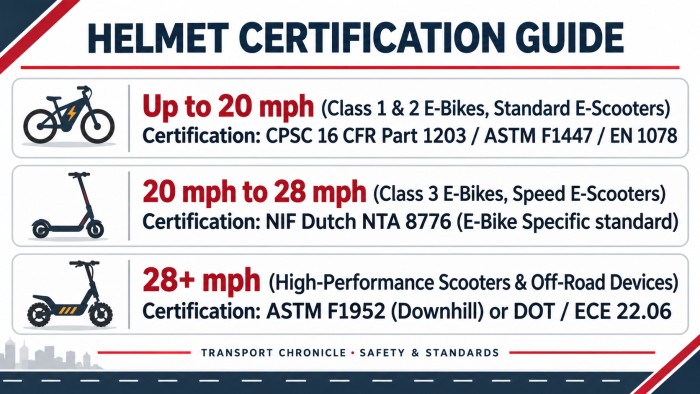
When selecting head protection for Texas micromobility commuting, standard consumer bicycle helmets may not offer sufficient protection at higher motor-assisted speeds.
Essential Helmet Features
- MIPS (Rotational Safety): Highly recommended, as most micromobility falls involve low-angle, rotational impacts rather than direct vertical impacts.
- NTA 8776 (Speed Rating): Essential for Class 3 e-bike users traveling up to 28 mph.
5. Civil Liability: Failure to Wear a Helmet in Injury Claims
Beyond municipal traffic citations, wearing a helmet plays a crucial role in personal injury litigation following a traffic collision.
Proportionate Responsibility
Under Texas Civil Practice and Remedies Code Chapter 33, Texas applies a modified comparative fault rule (51% bar rule):
- An injured rider can recover monetary compensation only if they are judged 50% or less at fault for their injuries.
- If a rider is assigned partial responsibility, their total monetary award is reduced in direct proportion to their percentage of fault.
The Comparative Negligence Defense
If a motorist negligently strikes an unhelmeted e-scooter or e-bike rider, the driver’s insurance company will routinely assert a helmet non-use defense.
- Injury Allocation: A jury may find the driver 100% responsible for causing the crash, but find the rider 20% to 40% responsible for worsening their head injury by failing to wear protective gear.
- Financial Reduction: If a jury awards $200,000 for traumatic brain injury damages, but assigns 30% comparative fault to the rider for not wearing a helmet, the ultimate payout is legally reduced by $60,000 to $140,000.
- Negligence Per Se: Riding an e-scooter on a sidewalk in a prohibited city zone (e.g., Downtown Dallas or Houston) creates negligence per se. This allows defense attorneys to prove rider fault automatically, drastically undermining injury claims.
6. Comprehensive Rider Compliance Checklist
To ensure full compliance with Texas laws, avoid financial penalties, and protect civil injury rights, riders should verify the following prior to operating e-scooters or e-bikes:
- Age & Class Limits: Verify that Class 3 e-bike riders are at least 15 years old (TTC § 551.107).
- Minor Helmet Check: Ensure all riders under 18 wear certified helmets to prevent local ordinance citations and parental fines.
- Night Illumination: Equipping devices with a front white lamp (500 ft visibility) and red rear light/reflector (300 ft visibility) (TTC § 551.104).
- Sidewalk Mapping: Avoid riding on sidewalks in central business districts or restricted zones across Austin, Dallas, Houston, and San Antonio.
- Speedometers: Confirm Class 3 e-bikes feature a visible, operational speedometer (TTC § 664.004).
- Legal Risk Management: Wear a helmet rated to CPSC or NTA 8776 standards to protect against traumatic head injuries and shield personal injury claims from comparative fault deductions under CPRC Chapter 33.