
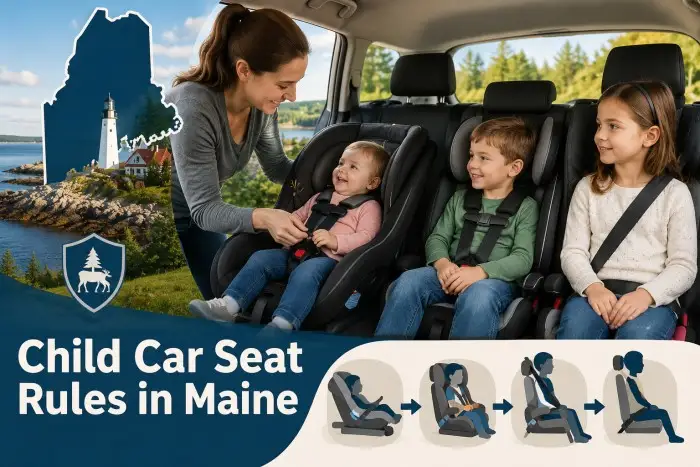
Keeping children safe while traveling is one of the biggest responsibilities for parents and drivers. In Maine, child car seat laws are designed to reduce injuries and protect young passengers in the event of a crash. Understanding these laws can help parents avoid fines while ensuring children are properly secured every time they ride in a vehicle.
This guide explains Maine’s child car seat requirements, the different types of car seats, safety recommendations, penalties, and practical tips for families.
Why Child Car Seats Matter
Car accidents remain one of the leading causes of injury for children in the United States. Properly installed child restraint systems significantly reduce the risk of serious injuries and fatalities. According to safety experts, using the correct car seat for a child’s age, height, and weight is more effective than relying only on a standard seat belt. Adult seat belts are not designed for small children and can cause severe injuries if used too early. Maine law follows this safety-first approach by requiring different restraint systems as children grow.
Maine Child Car Seat Laws
Maine has specific rules for infants, toddlers, and older children. These laws apply to anyone transporting children in a motor vehicle.
Rear-Facing Car Seat Requirement
Children under the age of 2 must ride in a rear-facing car seat. The rear-facing position provides better support for a baby’s head, neck, and spine during sudden stops or collisions. Most convertible car seats allow rear-facing use until children reach certain height or weight limits. Parents should keep children rear-facing as long as possible within the seat manufacturer’s guidelines, even after age 2 if the seat allows it.
Forward-Facing Car Seat Rules
After outgrowing the rear-facing seat, children should move to a forward-facing car seat with a harness system. In Maine, children weighing less than 55 pounds must be secured in an appropriate child restraint system. A forward-facing seat distributes crash forces more evenly across the stronger parts of a child’s body. Many modern seats include side-impact protection and adjustable harness systems for added safety.
Booster Seat Requirements
When children outgrow forward-facing harness seats, booster seats become necessary.
Under Maine law:
- Children under 8 years old
- Or children shorter than 57 inches
must use a booster seat or another suitable child restraint system. Booster seats help position the seat belt correctly across the chest and hips instead of the neck or stomach. There are two main types:
- High-back booster seats
- Backless booster seats
High-back models are often recommended for vehicles without headrests or for younger children transitioning from harness seats.
Seat Belt Rules for Older Children
Children who exceed the booster seat requirements may begin using standard seat belts.
However, a child should only use a regular seat belt when:
- The lap belt fits snugly across the upper thighs
- The shoulder belt rests across the chest and shoulder
- The child can sit with knees bent naturally over the seat edge
Even when legally allowed to use seat belts alone, children under 13 years old are safest riding in the back seat.
Maine’s Back Seat Recommendation
Although Maine law may not require all children to sit in the rear seat, safety experts strongly recommend it. Front airbags can seriously injure young children during deployment. The back seat provides additional protection, especially during front-end collisions.
For maximum safety:
- Infants and toddlers should always ride in the back
- Booster-seat users should stay in the rear whenever possible
- Avoid placing rear-facing seats in front of active airbags
- Penalties for Violating Maine Car Seat Laws
Failing to follow Maine child restraint laws can lead to fines and legal consequences.
Drivers may receive citations for:
- Not using the correct child restraint system
- Improperly securing a child
- Allowing children to ride without required protection
Beyond fines, improper restraint can increase liability during accidents and may affect insurance claims. More importantly, failing to use a proper car seat dramatically increases injury risks for children.
Choosing the Right Car Seat
Selecting the right car seat depends on several factors:
- Age: Infants need rear-facing seats, while older toddlers transition to forward-facing systems.
- Weight and Height: Always check manufacturer limits before moving to the next seat stage.
- Vehicle Compatibility: Some seats fit better in certain vehicles. Test installation whenever possible.
- Ease of Installation: A properly installed seat is safer than a complicated model used incorrectly. Parents should carefully read both the vehicle owner’s manual and the car seat instructions.
- Common Car Seat Installation Mistakes: Even high-quality car seats may not provide proper protection if installed incorrectly.
Common mistakes include:
- Loose harness straps
- Twisted seat belts
- Incorrect recline angle
- Moving to the next seat stage too early
- Using expired car seats
Car seats generally have expiration dates because materials can weaken over time. Parents should also avoid buying secondhand seats unless they know the complete crash history.
LATCH System Explained
Many modern vehicles include the LATCH system (Lower Anchors and Tethers for Children). This system allows car seats to attach directly to built-in anchors instead of using seat belts. It can simplify installation and improve stability when used correctly. However, every car seat has weight limits for LATCH use. Once children exceed those limits, installation with the vehicle’s seat belt may be required.
Winter Safety Tips for Maine Parents
Maine winters create unique challenges for child passenger safety. Heavy winter coats can prevent harness straps from fitting properly. During a crash, bulky clothing compresses, leaving dangerous slack in the harness.
Instead:
- Dress children in thin warm layers
- Tighten harness straps securely
- Place blankets over the harness after buckling
Parents should also ensure snow or ice does not interfere with proper seat installation.
Taxi, Rideshare, and Travel Considerations
Maine’s child restraint laws generally apply to personal vehicles, but parents should still prioritize safety during travel.
When using rideshare services or taxis:
- Bring portable booster seats when possible
- Confirm seat belt availability
- Never hold a child on your lap
For air travel, FAA-approved car seats provide safer protection than lap seating during turbulence.
Final Thoughts
Understanding Maine’s child car seat rules helps parents protect children at every stage of growth. From rear-facing infant seats to booster seats and proper seat belt use, every transition should happen only when children meet the necessary age, weight, and height requirements.
The safest approach is not just following the minimum legal standards, but also following best-practice safety recommendations from pediatricians and child passenger safety experts. A correctly installed car seat can make a life-saving difference in an accident. Taking a few extra minutes to secure children properly every trip is one of the simplest and most important safety decisions any driver can make.