
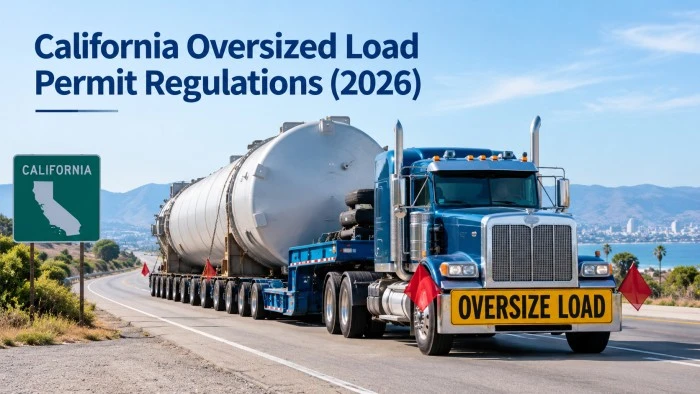
Operating extralegal vehicles across California’s highways requires precision, clear route planning, and strict adherence to rules set by the California Department of Transportation (Caltrans). As state infrastructure projects expand and freight traffic intensifies across major corridors, keeping up with oversized and overweight permit guidelines is essential for motor carriers, dispatchers, and heavy haulers.
This comprehensive guide outlines the core legal thresholds, permit options, escort parameters, and operational constraints for moving extralegal loads in California.
1. Legal vs. Extralegal Dimensions: Standard Limits
In California, any vehicle-cargo combination exceeding legal size or weight specifications is designated as an extralegal load and requires an official permit issued by Caltrans or local municipal jurisdictions.
| Transportation Topic | Key Details | Important Considerations |
|---|---|---|
| Road Transportation | Highways, freight movement, and road networks | Traffic conditions, road safety, and regulations |
| Commercial Trucking | Freight delivery and commercial vehicle operations | Load limits, permits, and compliance |
| Electric Vehicles | Electric cars, trucks, and charging infrastructure | Battery range, charging access, and sustainability |
| Transportation Regulations | Federal and state transportation requirements | Licensing, safety standards, and legal updates |
| Logistics and Freight | Supply chains, cargo handling, and shipment planning | Delivery schedules, costs, and efficiency |
Key Rule: Permits are issued strictly for non-reducible loads—cargo that cannot be reasonably broken down, disassembled, or split into legal legal dimensions without damaging the load or requiring excessive effort.
2. Caltrans Permit Types
The California Department of Transportation processes permit applications electronically through the official Caltrans Transportation Permit System (CTPS) portal. Selecting the right permit category depends on trip frequency, cargo dimensions, and routing requirements.
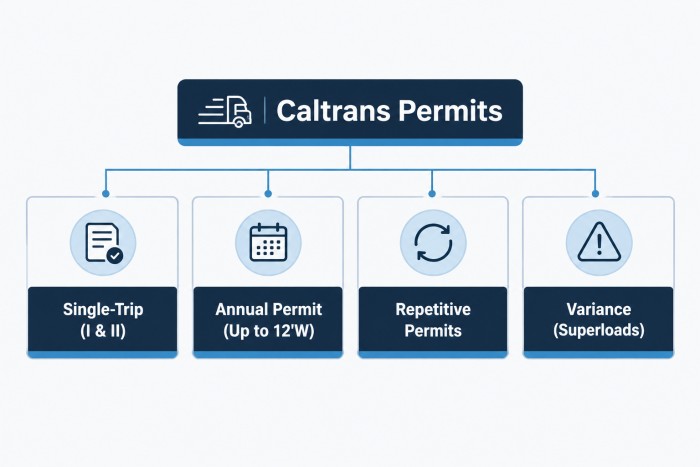
Single-Trip Permits (Single-Trip I & II)
- Scope: Valid for a single one-way or round-trip movement along a designated route within a specific timeframe (typically 3 to 7 days).
- Single-Trip I: Used for complex routes, custom clearing, rider form requirements, or when Caltrans needs to manually analyze and assign the route.
- Single-Trip II: Processed automatically via CTPS for standard extralegal dimensions on system-verified routes.
Annual Permits
Designed for carriers frequently moving qualifying non-reducible loads.
- Maximum Allowable Dimensions: Width up to 12 ft 0 in, Height up to 14 ft 0 in, Kingpin-to-Rear-Axle (KPRA) capped at 40 ft 0 in.
- Restrictions: Annual permit holders are strictly prohibited from operating on designated Red Routes and must check Caltrans’ Weekly Short-Term Restrictions (WSTR) updates prior to each haul.
Repetitive Permits
Used when the same oversize load is repeatedly transported along the exact same state route within a specified duration.
Variance Permits (Superloads)
Required for extreme extralegal dimensions:
- Width: Over 15 ft 0 in
- Height: 17 ft 0 in or greater
- Length: Exceeding 135 ft 0 in
- Weight: Exceptional heavy-haul axle configurations requiring complex bridge engineering evaluations.
Explore More- Massachusetts Oversized Load Permit Regulations (2026)
3. Escort Vehicle (Pilot Car) & Safety Requirements
California enforces stringent escort vehicle guidelines based on width, length, overhang, and route classification. Detailed provisions on safety parameters and vehicle clearances are published directly in the official Caltrans Transportation Permits Manual (TPM).
Pilot Car Triggers
- Width:
- 12 ft to 14 ft wide: Typically requires 1 Pilot Car (rear on multi-lane highways, front on two-lane roads).
- Exceeding 14 ft wide: Requires 2 Pilot Cars (front and rear).
- Exceeding 15 ft wide: May require California Highway Patrol (CHP) Escorts in addition to civilian pilot cars.
- Height: Loads exceeding 15 ft 6 in generally require a front pilot car equipped with a high-pole/clearance pole.
- Length: Combination lengths exceeding 120 ft or significant front/rear overhangs require escort management.
Equipment & Warning Markings
- Banners: Must measure at least 7 feet wide by 18 inches high with black letters (“OVERSIZE LOAD”) on a bright yellow background. Banners must be mounted on the front and rear of the transport vehicle.
- Flags: Square warning flags (minimum 18″x18″, bright red or fluorescent orange) must be positioned at the widest extremities and four corners of the load.
- Lighting: Warning lights (amber rotating or flashing beacons) are required for night runs or when specified by permit conditions.
4. Operational Restrictions & Travel Time Rules
Caltrans sets strict operating windows to prevent severe traffic congestion and optimize public safety. Detailed operational guidelines and statewide updates are maintained on the official Caltrans Transportation Permits Program portal.
OPERATIONAL WINDOWS
| Urban Curfews | Night Movement | Weekend / Holidays |
|---|---|---|
| Prohibited during peak commute hours (6–9 AM & 3–6 PM) in major metro areas. | Permitted for select over-height/over-width loads with explicit permit endorsement. | Restricted for broad loads; check local municipality rules. |
Urban Commute Curfews
Oversized loads are restricted from traveling on state highways within major metropolitan areas—such as Los Angeles, San Diego, Sacramento, and the San Francisco Bay Area—during peak traffic hours:
- Morning Peak: 6:00 AM – 9:00 AM
- Evening Peak: 3:00 PM – 6:00 PM
Holiday Restrictions
Extralegal load movements are prohibited on major state-observed holidays (e.g., New Year’s Day, Memorial Day, Independence Day, Labor Day, Thanksgiving, Christmas). Travel restrictions often apply starting at noon on the day preceding a holiday weekend.
5. Compliance Checklist for Motor Carriers
To avoid delays, fines, or permit revocations, follow this pre-trip workflow:
- Verify Cargo Reducibility: Ensure cargo cannot be legally dismantled to fit standard dimensions.
- Accurate Measurements: Measure the exact height, length, width, and axle spacings (measured sidewall-to-sidewall to the nearest inch).
- Submit via CTPS: Apply online through the Caltrans Transportation Permit System, providing complete VIN, vehicle weight charts, and axle layouts.
- Review Weekly Restrictions: Download the current Weekly Short-term Restrictions (WSTR) report to confirm bridge ratings and active construction zone closures.
- Secure Local Permits: Caltrans permits cover state highways only. Ensure separate permits are secured from local city or county public works departments when exiting state routes onto local roads.
- Brief Drivers and Escorts: Ensure the original signed permit copy, accompaniment sheets, and route maps are inside the cab before dispatch.
Final Guidance
Navigating California’s extralegal transport requirements demands diligent planning and close coordination with Caltrans and local authorities. Always review current route clearances via the CalRoute clearing database prior to dispatch to ensure a compliant and safe journey across the state’s highway system.