
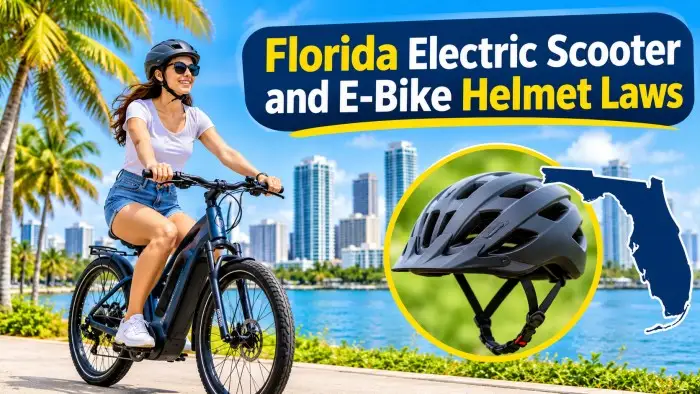
In Florida, riders and passengers under 16 years of age must wear a properly fitted, securely fastened helmet meeting federal safety standards when operating or riding on an electric bicycle or motorized scooter. Riders aged 16 and older are legally exempt from state helmet mandates, though local jurisdictions enforce strict municipal age restrictions, speed caps, and photo ID requirements.
Statutory Framework: How Florida Classifies E-Bikes and E-Scooters
Florida law regulates micromobility vehicles by grafting them onto the state’s existing bicycle traffic code. Rather than creating separate helmet statutes for electric devices, the Florida Legislature links both e-bikes and e-scooters directly to traditional bicycle rules under Chapter 316 of the Florida Statutes.
- Electric Bicycles (F.S. § 316.20655?): Under Florida Statute § 316.20655, e-bike operators hold the same rights, privileges, and traffic duties as traditional cyclists. This applies across all three statutory e-bike classes (Class 1 and Class 2 capped at 20 mph motor assistance; Class 3 pedal-assist capped at 28 mph).
- Motorized Scooters & Micromobility Devices (F.S. § 316.2128?): Under Florida Statute § 316.2128, electric scooter riders are bound by the same core bicycle duties under § 316.2065. Neither e-bikes nor e-scooters require a driver’s license, vehicle registration, title, or Personal Injury Protection (PIP) insurance at the state level.
- The Core Helmet Rule (F.S. § 316.2065(3)(d)?): Because both e-bike and e-scooter statutes incorporate Florida Statute § 316.2065, any operator or passenger under 16—including children riding in attached trailers or carriers—must wear a bicycle helmet that is properly fitted, securely fastened with a strap, and compliant with the U.S. Consumer Product Safety Commission (CPSC) standard (
16 C.F.R. part 1203).
| Regulatory Requirement | Electric Bicycles (Class 1, 2 & 3) | Motorized Scooters / E-Scooters |
|---|---|---|
| Mandatory Helmet Age | Under 16 years old (riders & passengers) | Under 16 years old (riders & passengers) |
| Adult Helmet Rule (16+) | Optional under state law | Optional under state law |
| Required Safety Standard | Federal CPSC (16 C.F.R. part 1203) | Federal CPSC (16 C.F.R. part 1203) |
| State Minimum Rider Age | None (subject to local city/county ordinances) | None (subject to local city/county ordinances) |
| Driver’s License / Tag | Not required | Not required |
Local Ordinances and 2025–2026 Municipal Enforcement Shifts
While state law sets the baseline for helmets, municipal governments hold broad statutory authority to regulate how, where, and by whom micromobility devices are operated.
- Local Age and Photo ID Mandates: Under legislative updates enacted in mid-2025 (amending §§ 316.20655 and 316.2128), Florida cities and counties are expressly authorized to pass local ordinances establishing minimum rider ages and requiring operators to carry a government-issued photo ID.
- Shared Fleet Restrictions: Commercial micromobility operators (such as Lime and Spin) enforce stricter contractual rules than state law. Most municipal share programs in cities like St. Petersburg, Tampa, and Miami restrict rentals to riders aged 18 and older, automatically placing their user base outside the state’s under-16 helmet mandate while requiring age verification through the rental app.
- Sidewalk Bans and Speed Zones: Even where adult helmets are optional, local authorities enforce strict geographic rules. High-pedestrian corridors—such as the Tampa Riverwalk, Bayshore Boulevard, and parts of Downtown Miami—enforce “No-Ride” geofences or reduced sidewalk speed limits (such as 7 mph in Miami and 10 mph in Hillsborough County).
- Rental Outfitter Liability: Under § 316.2065(15), commercial businesses are prohibited from knowingly renting or leasing a bicycle, e-bike, or scooter to a child under 16 unless the child already possesses a compliant helmet or the rental company provides one.
Penalties, Citations, and Civil Liability Rules
Enforcement of Florida’s helmet statute focuses heavily on corrective compliance rather than punitive fines, and state law shields unhelmeted riders in civil injury claims.
- Nonmoving Traffic Citations: Riding without a required helmet under age 16—or renting a device to an unhelmeted minor—is classified as a nonmoving violation punishable under Chapter 318 (typically carrying a modest statutory fine plus local court costs).
- First-Offense Dismissal: Under § 316.2065(3)(e), a court is legally required to dismiss a first-time helmet citation if the rider or parent presents proof of purchase of a compliant, CPSC-certified helmet.
- Parental Responsibility: Parents and legal guardians are prohibited from authorizing or knowingly permitting a minor ward to ride without a required helmet.
- Protection Against Comparative Negligence: Under § 316.2065(18), failure to wear a helmet—or a parent’s failure to prevent a child from riding without one—cannot be admitted as evidence of negligence or contributory negligence in a civil personal injury lawsuit. If a motorist strikes an unhelmeted e-bike or scooter rider, insurance carriers cannot legally reduce the rider’s damages solely because they were not wearing a helmet.
Safety Standards and Gear Selection for Electric Speeds
A standard bicycle helmet satisfies Florida’s legal requirement for minors, but electric propulsion changes crash dynamics. Class 3 e-bikes reach 28 mph under pedal assist, and e-scooters feature small wheel diameters and high centers of gravity that increase forward-pitch fall risks.
- CPSC vs. NTA 8776 Certification: While
16 C.F.R. part 1203(CPSC) is the legal minimum for riders under 16, adult e-bike commuters frequently opt for helmets certified to the Dutch NTA 8776 standard. NTA 8776 helmets are engineered specifically for speed pedelecs up to 28 mph, offering deeper coverage around the temples and back of the skull and absorbing higher impact velocities than standard cycling helmets. - Rotational Impact Protection: Look for helmets equipped with slip-plane liners (such as MIPS or WaveCel), which help redirect angled rotational forces common in pavement falls.
- Proper Fit Verification: A helmet only meets Florida’s “properly fitted and securely fastened” standard when the front rim sits level one to two finger-widths above the eyebrows, the side straps form a tight “V” directly under each earlobe, and the chin strap allows no more than one finger of slack beneath the jaw.
- When a Device Becomes a Moped or Motorcycle: If an e-bike is modified to exceed 750 watts or lacks functional pedals, or if a seated scooter exceeds statutory speed thresholds, it loses its micromobility exemption. Law enforcement may classify it as a moped or motorcycle under § 316.211, triggering mandatory DOT-approved headgear (for riders under 21 or adults without $10,000 in medical insurance coverage), eye protection, registration, and driver licensing requirements.