
Japan to Bolster Self-Defense Forces’ Island Logistics and Evacuation Capabilities using AI Driven autonomous vessels.
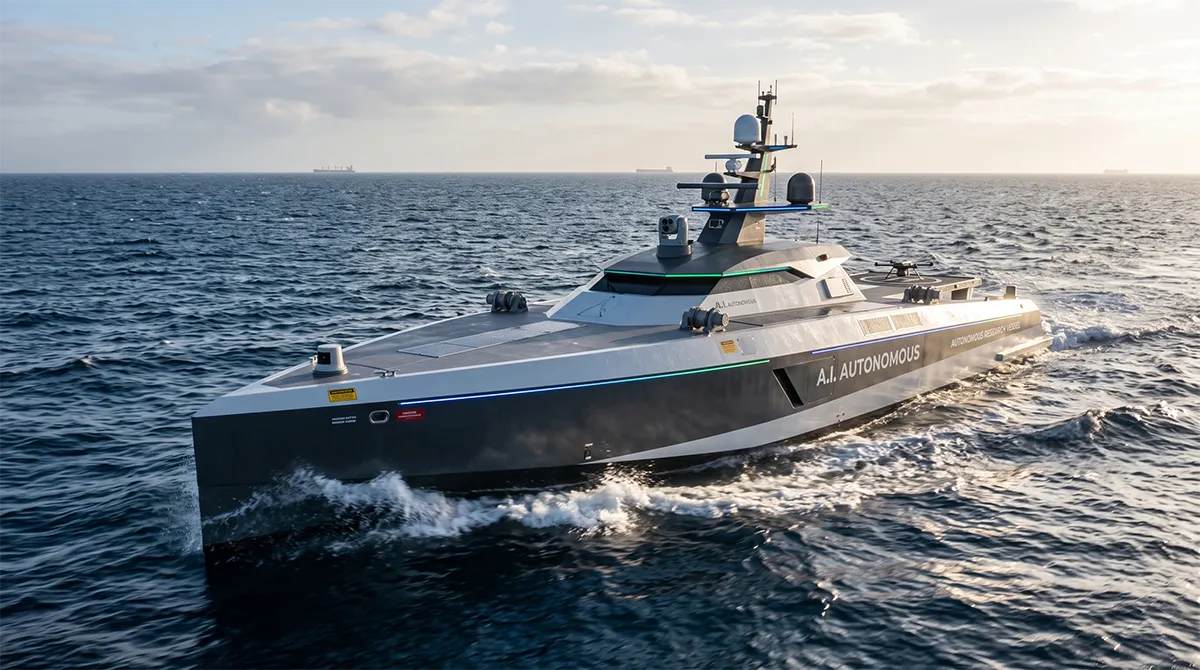
Japan’s Defense Ministry is moving forward with research into transport ships equipped with artificial intelligence and autonomous navigation systems, aiming to strengthen maritime supply lines and civilian evacuation options for remote islands amid personnel shortages and regional security concerns.
According to government sources, the initiative will be incorporated into the three key national security documents due for revision by the end of 2026. Formal studies and research are set to begin in fiscal 2027 (starting April 2027), with the project included as an “item request” in the ministry’s initial budget outline—meaning no specific funding figure has been assigned yet.
The vessels would rely on AI to integrate data from cameras, radar, satellites, and environmental sensors. This would enable automated route planning, navigation in both coastal and open waters, docking and undocking, and real-time adjustments for conditions such as tidal currents and wave heights. The goal is to operate ships with significantly fewer crew members, with fully unmanned operations under consideration in the longer term.
Primary uses include large-scale movement of Self-Defense Forces (SDF) personnel, ammunition, fuel, and other supplies to the Nansei (southwestern) Islands during a contingency, as well as the safe evacuation of residents from remote islands. These islands, surrounded by sea and viewed as strategically vital given potential regional tensions, depend on reliable maritime transport as a critical lifeline for deterrence and sustainment.
The push addresses a dual challenge: Japan’s declining birth rate and resulting manpower constraints within the SDF, and the need to maintain transport networks even in high-risk waters. A senior ministry official described autonomous vessels as a “beacon of hope” for extending operational endurance in harsh environments while reducing risks to personnel.
This builds on recent organizational changes. In 2025, the SDF established the Maritime Transport Group, a joint unit drawing from the Ground, Maritime, and Air Self-Defense Forces, specifically to improve movement of troops and materiel to remote locations. Existing military transport assets and planned expansions of privately financed initiative (PFI) vessels are seen as insufficient alone for a major island contingency, making commercial shipping capacity an important complement.
Private-sector progress is providing a technological foundation the ministry is expected to draw upon. The Nippon Foundation’s MEGURI2040 project, launched in 2020 with shipbuilders and operators, has advanced autonomous systems to the point of commercial operations. In early 2026, multiple vessels—including a new-build coastal container ship, a Ro-Ro vessel, and a passenger ferry—received official certification for Level 4-equivalent autonomous navigation (comparable to advanced automotive autonomy) and began carrying passengers or cargo on regular routes. Shore-based support centers can now monitor and assist multiple ships simultaneously, a first of its kind. Technologies for high-traffic waters and remote docking support have been demonstrated.
Related efforts include examining how existing commercial vessels could be modified for automated or remotely supervised navigation, with studies expected to assess retrofit requirements by ship type over roughly a one-year period through the end of fiscal 2027. Parallel developments in the Maritime Self-Defense Force, such as reduced-crew designs on newer patrol vessels, reflect a broader labor-saving trend.
The approach also aligns with lessons from recent conflicts highlighting the value of advanced technology in logistics and unmanned systems. By blending commercial innovations with defense needs, Japan seeks more resilient, lower-risk maritime transport options for both peacetime sustainment and emergency response in its southwestern island chain.
Research and integration details will continue to take shape as the national security documents are finalized and budget decisions are made later this year.
source: Aisa News