
Almost $31–32 Billion in Automaker Investment Commitments Underscore India’s Rise as a Global Auto Manufacturing, R&D and Export Hub
India’s automobile industry is witnessing an unprecedented wave of capital commitments from major domestic and global players, with announced investments across different timelines totaling nearly $31–32 billion. The scale reflects growing confidence in India not merely as a large domestic market but as a strategic base for manufacturing, research and development, localisation and exports.
The standout announcement came on October 13, 2026, when Hyundai Motor Group committed $15.5 billion for the period 2026–2032. The seven-year plan followed a meeting between Group Executive Chair Euisun Chung and Prime Minister Narendra Modi in New Delhi. It covers capacity expansion at Hyundai Motor India and Kia India facilities, roughly $700 million for the Indian R&D centre (including a vehicle testing track), supplier development, localisation, and exploration of new areas such as specialised automotive financing, EV charging infrastructure and end-of-life vehicle recycling. A dedicated investment entity will coordinate the programme.
Hyundai Motor Group already operates more than 1.4 million units of annual production capacity in India (Hyundai Chennai ~824,000, Pune ~170,000, Kia Anantapur ~431,000) and employs over 24,000 people. Roughly 60% of the new outlay is expected to go toward manufacturing upgrades and expansion, with the balance directed at emerging technologies (including AI), R&D and talent. The group aims to position India as one of its leading global export platforms.
Source: Reuters
Other major Auto Investment commitments in 2026 include:
- Maruti Suzuki India: Approximately $8.2 billion (₹77,500 crore) in capital expenditure from FY27 to FY31 for capacity expansion (targeting up to 4 million units annually from current levels near 2.9 million), new models, R&D, plant maintenance, sales infrastructure, carbon-reduction measures and logistics. FY27 alone is budgeted at roughly $1.5 billion (₹14,000 crore, up ~40% year-on-year). Source: Business-Standard
- Tata Motors Passenger Vehicles: Approximately $3.5–3.7 billion (₹33,000–35,000 crore; some related planning references nearer $4.0–4.2 billion) for FY26–30, focused on new products, software-defined vehicles, advanced technologies, powertrains and capacity to support ambitions of higher market share and volumes approaching 1.2 million units annually by around 2030.
- Mahindra & Mahindra: Approximately $2.8 billion (₹27,000 crore) for the auto business in FY25–27 (part of a broader group plan), directed at product development, capacity creation (including potential greenfield expansion), ICE SUVs, EVs and commercial vehicles. Source: Money Control
- Honda Cars India: Approximately $126 million (₹1,200 crore) to retool its Tapukara (Rajasthan) plant for production of the ‘0 Alpha’ electric SUV, aimed at domestic and export markets.
- Citroën / Stellantis: Approximately $210 million (₹2,000 crore) additional investment (2024–2030 timeframe) in Tamil Nadu for capacity, R&D at the Chennai Tech Centre, and both ICE and EV manufacturing under the Citroën brand, building on earlier commitments.
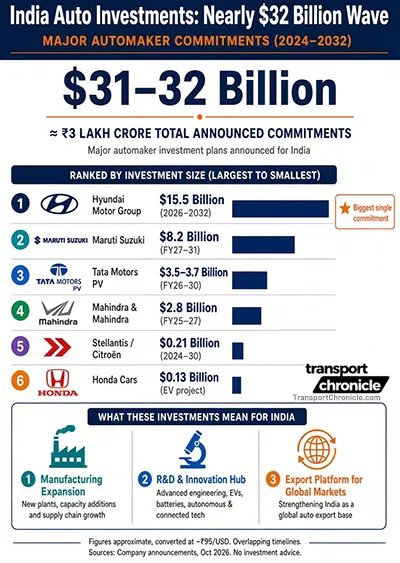
These figures—spanning overlapping but distinct periods and business segments—add up to nearly $31–32 billion from just this group of players. Broader industry context includes significant ongoing PLI scheme investments and further capacity plans across the sector.
India’s attractiveness stems from robust domestic demand growth prospects, policy support for manufacturing and localisation (“Make in India”), a maturing supplier base, competitive costs, and its emerging role as an export platform for markets in Asia, Africa, the Middle East and beyond. Global automakers increasingly view the country as a hub for next-generation technologies, including electrification, hybrids, software-defined vehicles and advanced R&D.
The investments also highlight opportunities further down the value chain. Every new or expanded vehicle plant generates demand for hundreds of component suppliers—bearings, wiring harnesses, forgings, castings, electronics, sensors, motors, transmissions, tyres and more. As vehicles grow more sophisticated (higher electronic content, EVs, premium features), the value of components per vehicle tends to rise. India’s auto ancillary sector has already seen strong revenue growth and has a substantial project pipeline driven by localisation, EV content, premiumisation and exports. Source: Autocarpro
Announced capital expenditure does not automatically translate into profits. Successful execution, timely capacity utilisation, supply-chain readiness, return on capital, and navigation of raw-material, technology and demand risks will be critical. Still, the sheer scale of commitments signals a structural shift: India’s automobile ecosystem is attracting long-term capital at a remarkable level, positioning the country more firmly as a global manufacturing and innovation base rather than solely a consumption market.
No investment recommendation. This article is for informational purposes based on publicly reported company announcements and industry developments as of mid-October 2026. Currency conversions are approximate using a rate of ~₹95 per US dollar and may vary with actual exchange rates and precise announcement dates.