
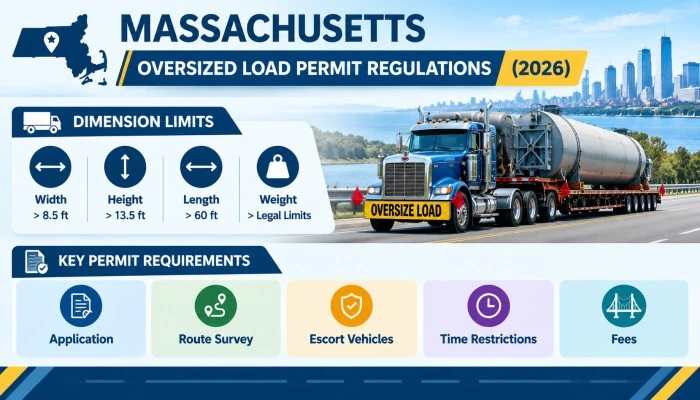
Navigating commercial freight movement through the Commonwealth of Massachusetts requires strict adherence to state and federal safety guidelines. The Massachusetts Department of Transportation (MassDOT), in coordination with the Massachusetts State Police (MSP) Commercial Vehicle Enforcement Section, strictly regulates non-divisible and divisible freight exceeding legal dimensions or weight limits.
Below is an exhaustive compliance guide on Massachusetts oversized load permit regulations, incorporating legal limits, superload definitions, pilot car protocols, curfew schedules, and official state resources.
1. Statutory Size and Weight Boundaries
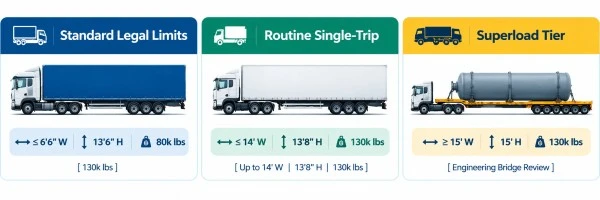
A commercial transport configuration moving through Massachusetts is classified as an Oversized/Overweight (OS/OW) load if it exceeds any of the following standard legal limits:
- Overall Width: 8 ft 6 in (102 inches)
- Overall Height: 13 ft 6 in (12 ft 6 in maximum inside the Sumner and Callahan Tunnels)
- Overall Length: 53 ft semi-trailer (80 ft overall combination length)
- Gross Vehicle Weight (GVW): 80,000 lbs
- Legal Overhang Limits: 3 ft front overhang; 4 ft rear overhang
Axle Weight Limitations
Massachusetts enforces strict maximum axle weights on all state highways and interstate corridors.
| Axle Group Configuration | Interstate Maximum | Non-Interstate Maximum |
|---|---|---|
| Single Axle | 22,400 lbs | 22,400 lbs |
| Tandem Axle | 34,000 lbs | 36,000 lbs |
| Tridem Axle | Federal Bridge Formula | 36,000 lbs (varies by spacing) |
| Gross Vehicle Weight (GVW) | 80,000 lbs | 80,000 lbs |
2. Permit Classifications & Fee Structures
MassDOT categorizes permits into single-trip routine, annual blanket, and superload tiers depending on dimensions, trip frequency, and structural impact.
Routine Single-Trip Permits
- Applicability: Issued for non-divisible loads exceeding legal limits but remaining under superload thresholds.
- Maximum Routine Dimensions: Up to 14 ft wide, 13 ft 8 in high, 115 ft long, and up to 130,000 lbs GVW.
- Validity Period: Valid for 5 consecutive travel days.
- Base Cost: Starts at a $40 base fee for standard non-divisible single trips.
Annual Blanket Permits
- Applicability: Granted to carriers making frequent OS/OW trips with bounded dimensions.
- Maximum Dimensions: Up to 14 ft wide, 14 ft high (height survey required if over 13 ft 8 in), and 115 ft in overall length.
- Cost: Annual permits typically run approximately $400 per power unit.
Explore ore- Massachusetts Electric Scooter and E-Bike Helmet Laws
Superload Category
Any load crossing any one of the following thresholds automatically upgrades to Superload status:
- Width: 15 ft or greater
- Height: 15 ft or greater
- Length: 135 ft or greater
- Gross Vehicle Weight: Greater than 130,000 lbs
Superload Requirements: Single-trip Superload permits cost a baseline of $300. Weight-based superloads require a professional structural engineering bridge analysis to evaluate load distributions across bridges and culverts along the proposed path. Maximum absolute superload width within the Commonwealth is restricted to 16 ft unless given explicit executive authorization.
3. Escort Vehicles & Route Survey Requirements
Depending on physical measurements, carriers must secure certified civilian pilot cars, specialized height poles, or Massachusetts State Police details.
Escort Matrix
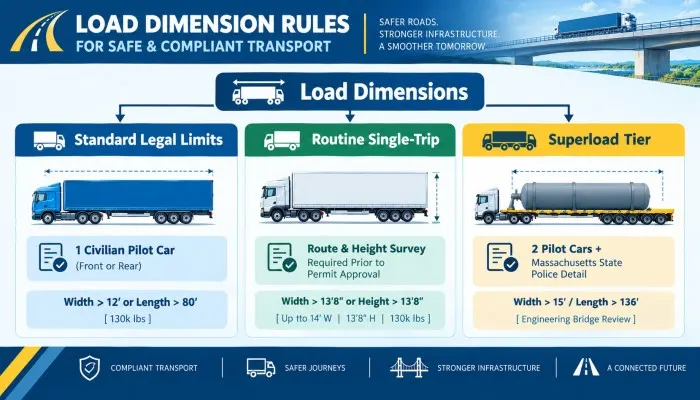
- Height Survey Mandate: Any load with an overall height exceeding 13 ft 8 in requires a physical route survey. The route must be driven prior to permit submission with a certified height pole to verify overhead utility, bridge, and signal clearances.
- Special Regions: Cape Cod and Boston proper enforce distinct, stricter escort minimums. For instance, loads exceeding 12 ft wide crossing Cape Cod or navigating the City of Boston require dedicated local or State Police details.
- Massachusetts Turnpike (I-90): Hauling over 12 ft wide, 100 ft long, or over 130,000 lbs on I-90 requires a police escort detail and an additional MassPike engineering review fee (calculated at 25% of the state roadway permit fee).
Explore More- Navigating Port Drayage Regulations & Container Dwell Fees at the Port of Boston
4. Safety Equipment and Flagging Standards
All oversized configurations must meet MassDOT visual warning mandates:
- Warning Banners: Front and rear “OVERSIZE LOAD” signs are mandatory on all oversized vehicles not accompanied by police escorts. Banners must measure 7 ft wide by 18 inches high, featuring 10 inch black lettering on a yellow background.
- Safety Flags: Bright red or orange flags (minimum 12 inches square) must be positioned at all extreme corners, widest projection points, and rear overhang limits.
- Illumination: Permitted nighttime movements require a roof-mounted 360-degree rotating or strobe amber light visible from at least 500 feet.
5. Travel Time Windows and Commuter Curfews
Movement windows depend on the overall dimensions of the load:
- Standard Movements (Up to 12 ft Wide): May travel continuously from Monday at 12:01 AM through Saturday at 12:00 PM (noon), and Sunday from 12:01 AM through 12:00 PM (noon). Movement is prohibited from Saturday noon to Sunday midnight.
- Daylight-Only Window (12 ft to 14 ft Wide / Lengths over 80 ft): Restricted to travel strictly between sunrise and sunset.
- Superload Windows (Over 14 ft Wide or Over 115 ft Long): Restricted to movement between 9:30 AM and 3:30 PM, Monday through Thursday only.
- Boston Commuter Curfew: No movement of oversized loads is permitted on major arterial highways—including I-93, I-95, and I-90 in the Greater Boston urban corridor—during weekday peak traffic blocks:
- Morning Curfew: 7:00 AM – 9:00 AM
- Evening Curfew: 3:30 PM – 7:00 PM
- Holiday Closures: No permitted travel is allowed on major state holidays, including New Year’s Day, Memorial Day, Independence Day, Labor Day, Thanksgiving Day, and Christmas Day.
6. Regulatory Compliance & Government Sources
To process applications, review temporary closures, or consult statutory provisions, refer directly to official Commonwealth portals:
- Apply for online electronic permits via the official MassDOT Commercial Truck Permits Portal.
- Access statutory regulations, bridge clearance databases, and highway rules through the MassDOT Highway Division Regulations.
- Verify vehicle registration, fuel licensing, and IRP compliance details via the Massachusetts Registry of Motor Vehicles (RMV) Motor Carrier Services.