A comprehensive operational, regulatory, and financial guide for supply chain managers, BCOs, freight forwarders, and drayage carriers navigating Massachusetts Port Authority (Massport) facilities.
Executive Summary & Quick Reference
The Paul W. Conley Container Terminal in South Boston is New England’s only full-service container port facility, serving over 2,500 regional importers and exporters. Following Massport’s multi-million-dollar modernization project—which added a 50-foot deep berth and neo-Panamax cranes—the terminal handles container ships ranging from 12,000 to 16,000 TEUs.
While Conley Terminal maintains an industry-leading average truck turn time of ~30 minutes, logistics professionals must navigate strict terminal drayage compliance standards and avoid escalating container dwell and demurrage penalties.
| Category | Details |
|---|---|
| Facility Operator | Massachusetts Port Authority (Massport) |
| Primary Terminal | Paul W. Conley Container Terminal (BOS) |
| Operating System (TOS) | Tideworks Mainsail / Forecast Module |
| Access Route | Thomas J. O’Connor Dedicated Haul Road |
| Average Truck Turn Time | ~30 Minutes |
| Primary Regulatory Standard | FMC OSRA 2022 & Massport Tariff Schedules |
Part 1: Port of Boston Drayage Regulations & Access Protocols
Drayage motor carriers entering Conley Container Terminal must comply with state, federal, and Massport-specific operational rules designed to maintain gate velocity and community safety.
1. Driver Credentials & Equipment Registration
- TWIC (Transportation Worker Identification Credential): Every driver entering the secure port facility must possess an active, unexpired credential via the TSA TWIC Program.
- Terminal Operating System (TOS) Integration: Trucking companies must register with Massport’s Tideworks Mainsail Forecast Portal. This platform allows carriers to verify container availability, check customs hold statuses, manage bookings, and validate pre-gate documents prior to dispatching equipment.
- Dedicated Haul Road Routing: To prevent truck congestion across residential South Boston neighborhoods, all heavy commercial drayage traffic must access the terminal via the Thomas J. O’Connor Dedicated Haul Road. Review the official Massport Guidelines for Truckers before routing drivers. Bypassing the designated freight corridor can result in port privilege revocations and municipal traffic citations.
2. Standard Operating Procedures for Gate In/Out Transactions
Massport enforces strict validation checkpoints during each gate transaction:
A. Inbound / Outbound Move Types
- FULLOUT (Import Delivery): The container must have all U.S. Customs and Border Protection (CBP) and USDA holds released, freight cleared by the ocean carrier, and all Massport terminal usage, inspection, and demurrage fees settled.
- FULLIN (Export Delivery): Requires an active Export Booking Guarantee lodged in the system, along with an IMO Dangerous Goods Declaration (if handling Hazmat) and an official dock receipt.
- MTIN / MTOUT (Empty Returns and Pickups): Managed in coordination with equipment control allocations from individual ocean lines.
B. Scale and Pre-Gate Lanes
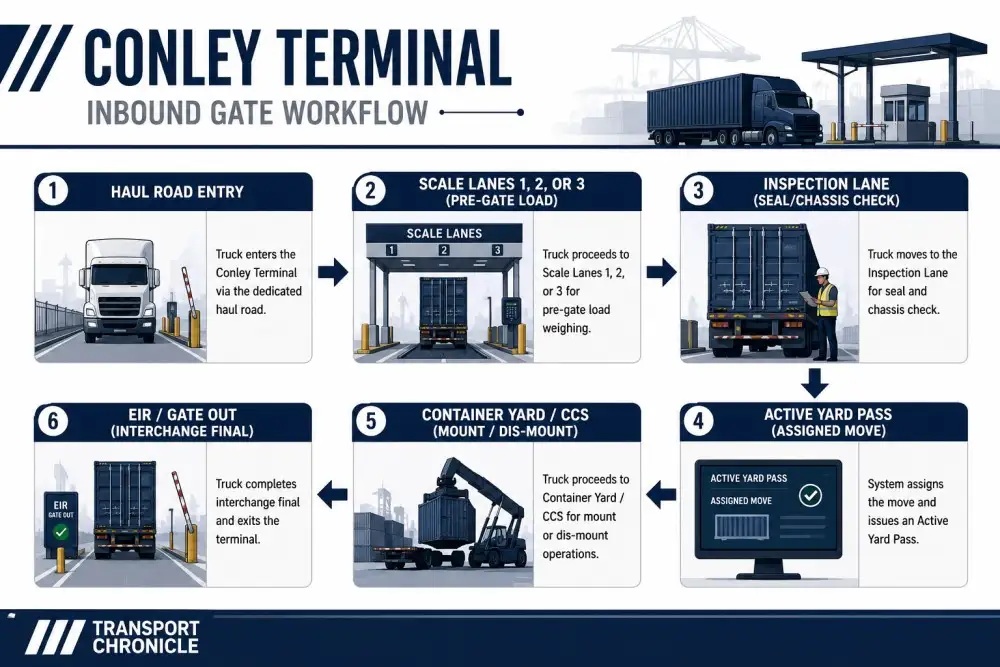
- All inbound loaded containers must enter via Scale Lanes 1, 2, or 3 to obtain gross certified container/cargo weights before proceeding.
- Drivers move to the Inspection Lane to verify container physical integrity and match seal numbers against the manifest (C-TPAT compliance).
- Once verified, an active Yard Pass is generated, specifying equipment number, move type, and container line. Upon interchange completion, the driver exchanges the Yard Pass for an official Equipment Interchange Receipt (EIR).
C. Refrigerated Cargo (Reefers) & Genset Standards
- Any reefer unit delivered to Conley Terminal must match the set-point temperature indicated in the booking. If the variance between the physical thermometer reading and the booking set-point exceeds acceptable terminal thresholds, the unit will be turned away.
- Returned gensets must be fully operational at the time of interchange.
Part 2: Demurrage, Detention, and Container Dwell Fees
Managing storage fees at the Port of Boston requires a clear distinction between terminal-level storage penalties and carrier equipment usage fees.
| Charge Type | Location Assessed | Party Invoicing |
|---|---|---|
| Demurrage | Inside Terminal (Grounded) | Massport / Ocean Carrier |
| Container Dwell | Inside Terminal (Yard) | Port Authority (Congestion) |
| Detention / Per Diem | Outside Terminal (Street) | Ocean Carrier / Chassis Pool |
| Driver Detention | Facility / Gate Queuing | Motor Carrier (Drayman) |
1. Free Time Calculations at Conley Terminal
- Standard Free Time: For standard dry containers, import free time typically begins at 08:00 AM on the first business day after the container is completely discharged from the vessel and made available in the yard.
- Working Days vs. Calendar Days: Standard dry boxes generally receive 4 to 5 free working days (excluding weekends and official Massport terminal holidays), while temperature-controlled (reefer) and specialized equipment typically receive 2 to 3 free days due to plug-in infrastructure limitations.
- The Last Free Day (LFD): The final calendar date before storage fees begin accruing.
2. Tiered Demurrage Fee Schedule
When a container exceeds its LFD, daily penalties accrue on an escalating scale to discourage terminal floor storage:
| STORAGE INTERVAL (PAST LFD) | STANDARD DRY CONTAINERS (20’/40’/45′) | REFRIGERATED & TANK CONTAINERS |
|---|---|---|
| Days 1 – 4 (Tier 1) | $125 – $175 / container / day | $250 – $350 / container / day |
| Days 5 – 8 (Tier 2) | $200 – $275 / container / day | $375 – $475 / container / day |
| Day 9+ (Tier 3 – Extended) | $325 – $450+ / container / day | $550 – $700+ / container / day |
(Note: Always consult the official Massport Conley Terminal Tariffs Page and your ocean bill of lading for contract-specific rate adjustments).
Part 3: Regulatory Compliance (FMC & OSRA 2022)
Under the Ocean Shipping Reform Act of 2022 (OSRA 2022) and the Federal Maritime Commission (FMC) Demurrage & Detention Rules (46 CFR Part 541):
- Invoicing Requirements: Demurrage and dwell invoices must be issued exclusively to either the consignee (the beneficial cargo owner) or the contract party who booked ocean carriage.
- Mandatory Invoice Data Elements: Invoices must clearly state:
- Container availability date and vessel arrival date.
- Last Free Day (LFD) calculation schedule.
- Specific dates on which demurrage or storage accrued.
- Clear instructions on how to submit fee mitigation or dispute requests.
- The “Reasonable Incentive” Principle: Storage fees are designed solely as operational incentives to promote cargo fluidity. If terminal closures, government holds (e.g., CBP exam hold beyond shipper control), or gate system outages prevent a motor carrier from retrieving a box, demurrage cannot legally be assessed for those inaccessible days.
Part 4: Best Practices to Eliminate Port Dwell & Demurrage
Proactive Pre-Clearance Checklist
- Review Manifest / Ocean Bill of Lading (OBL) for accuracy
- Ensure customs entry is filed via Automated Commercial Environment (ACE)
- Verify terminal credit arrangements with Massport and Ocean Carrier
- Confirm absence of CBP, USDA, or Coast Guard holds in Tideworks Mainsail
- Confirm availability of chassis (CCS equipment pool)
- Schedule drayage slot and assign qualified TWIC-carded driver
- Note the exact Last Free Day (LFD) in your freight management system
- Pre-gate export or empty return transactions in Scale Lanes 1–3
- Exchange active Yard Pass for EIR before driver leaves terminal premises
Risk Mitigation Strategies
- Leverage Tideworks Mainsail Alerts: Use the Conley Terminal Container Tracking Tool to configure automated alerts for customs releases or when boxes move to active stacks.
- Pre-Pay Ancillary Charges: Pay terminal usage fees and USDA/CBP exam handling fees ahead of gate dispatch to prevent gate delays.
- Use Off-Dock Container Yards (CY): If your distribution center cannot accept immediate delivery, arrange a drayage pull to an off-dock container yard in Greater Boston or Central Massachusetts before the Last Free Day to transition from high terminal demurrage to lower off-dock storage rates.
Frequently Asked Questions (FAQ)
What happens if my container is selected for a CBP or USDA Exam at Conley Terminal?
Containers flagged for inspection generally fall into two categories:
- CUST EXAM (On-site / Direct Delivery): Units move directly to the exam facility; the container does not return to the primary terminal stack.
- UNCL (Uncleared Exam Moves): Units move under customs bond to an off-site inspection station and must return to Conley Terminal for final clearance before street release.
Who pays demurrage at Conley Terminal: the drayage trucker or the BCO?
Demurrage is the responsibility of the cargo owner (BCO/Consignee) or the ocean line depending on service contracts. Under FMC billing guidelines, terminal operators and ocean carriers cannot bill demurrage to drayage motor carriers who are not party to the ocean contract.
Does Conley Terminal require mandatory appointment slots?
Unlike large West Coast port complexes (e.g., LA/Long Beach), Conley Terminal relies primarily on streamlined pre-gating via Tideworks Mainsail Forecast combined with its Scale Lanes 1–3 pre-gate workflow. This process maintains an average turn time of ~30 minutes without a restrictive hourly quota system.