
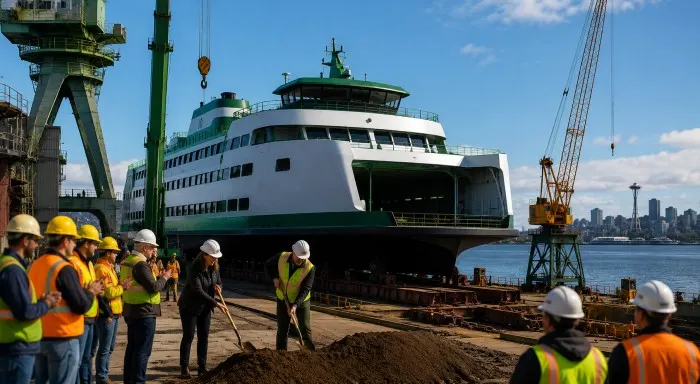
Washington’s fleet of diesel-burning ferries is finally getting a long-awaited overhaul. Construction has officially begun on a new generation of hybrid-electric vessels that will replace some of the state’s oldest boats, marking the first newbuild ferry program in more than a decade.
Florida Shipyard Wins the Contract
The build is taking place far from Puget Sound — at Eastern Shipbuilding Group’s yard in Panama City, Florida. Under the terms of the agreement, Eastern will deliver three 160-vehicle ferries, each with capacity for up to 1,500 passengers and running on a combination of battery power and diesel backup to reduce emissions. The vessels will be assembled using a modular process on dry land before being slid into Florida’s St. Andrew’s Bay for launch. The first ferry — set to be named the Wishkah — is expected to be ready by summer 2030, with the second and third following in 2031 and 2032, according to Governor Ferguson’s official announcement.
A Costly but Necessary Investment
The financial scope of the project is significant. The three new ferries carry a base construction cost of $714.5 million, with additional expenses for owner-furnished equipment, construction management, crew training, and contingency planning pushing the total contract value to $1.15 billion — notably still under the $1.3 billion the state Legislature had originally set aside for the program. According to the governor’s office, Eastern Shipbuilding’s winning bid came in roughly 30% lower than the competing Washington-based proposal, a difference officials say saved taxpayers an estimated $240 million.
A Three-Ship Order, Not Two
The original contract only guaranteed two new ferries, with an option for a third. This week, Governor Ferguson confirmed the state is exercising that option, locking in all three vessels as part of what his office is calling one of the most significant ferry modernization efforts in the country.
Why Washington Is Going Hybrid
This isn’t a sudden decision — it’s the product of years of planning. Washington State Ferries has long been flagged as the state’s single largest source of greenhouse gas emissions among government agencies, and the push toward electrification traces back to a 2018 executive order signed by then-Governor Jay Inslee. Since then, the state has mapped out an ambitious roadmap, detailed in WSDOT’s ferry system electrification plan, to deploy 16 new hybrid ferries and retrofit six existing vessels into plug-in boats by 2040.
The Wenatchee Already Set a Precedent
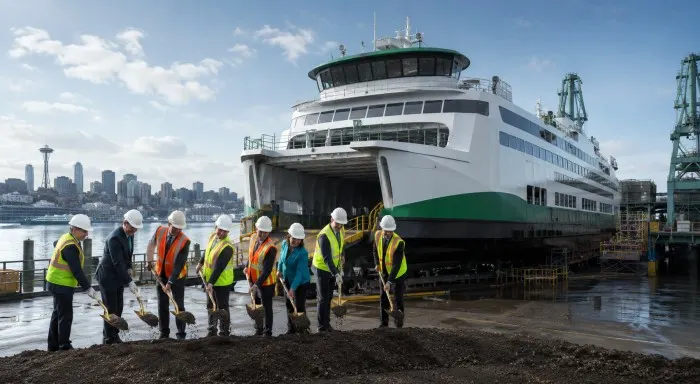
Washington has already had success with hybrid conversions: the Wenatchee, a 202-vehicle ferry, began operating the Seattle-Bainbridge Island route last summer, making it the largest battery-powered ferry currently operating in North America. Two sister vessels in the Jumbo Mark II class are slated for similar conversions, though funding for those upgrades wasn’t included in the state’s supplemental transportation budget passed in March.
An Aging Fleet Under Pressure
The urgency behind this build is easy to understand once you look at the numbers. Washington operates the largest ferry system in the country. Yet the fleet has shrunk significantly — from 25 vessels in 2015 down to just 21 today, according to the governor’s office — with 11 of those boats already over 40 years old, including one vessel that’s 67. State transportation officials say the system will eventually need 26 ferries to meet demand reliably.
Despite the aging fleet, service has actually been trending upward: the governor’s office reports that 2025 saw nearly 70% fewer cancellations compared to 2024, alongside 4,000 additional sailings and 500,000 more passengers served.
Construction Kicks Off
Work officially began this week with a ceremonial steel-cutting event at Eastern’s shipyard in Panama City. Governor Ferguson was unable to attend in person due to wildfire response efforts back home, but he acknowledged the milestone in a public statement, noting that the state has lost four ferries to retirement over the past decade and calling this the start of a critical rebuilding effort for more dependable ferry service. Washington State Ferries Deputy Secretary of Transportation Steve Nevey, who represented the agency at the ceremony, said the steel cutting marks the moment where years of planning “becomes visible progress.”