
Defense transportation covers the movement of personnel, equipment, fuel, ammunition, and supplies across air, land, sea, and increasingly autonomous domains. In 2026, three forces are pushing it to the front of the agenda:
The first is contested logistics. Conflicts in the Middle East and Eastern Europe have forced planners to assume that supply lines themselves are targets. The second is the rise of AI-enabled visibility, where commanders demand real-time, multi-modal tracking of every container, fuel truck, and aircraft. The third is platform modernization — fleets built in the 2000s are now being replaced with hybrid, electric, and autonomous variants.
April 2026 brought significant news on all three fronts.
1. NATO Logistics Committee Meets in Brussels to Reinforce Collective Defense Readiness
On April 28, 2026, NATO’s Logistics Committee convened at NATO Headquarters in Brussels in one of the most substantive logistics gatherings of the year. National Armaments Directors, Logistics Directors, and senior planners reviewed the Alliance’s progress on collective defense logistics readiness.
The discussion centered on four pillars: preparing and exercising reinforcement movements across the Atlantic and within Europe, implementing NATO’s Logistics Action Plan, delivering Host Nation Support obligations, and operating effectively in contested environments where supply lines may be jammed, intercepted, or disrupted. Member states also focused on harmonizing common logistics standards and on operational energy — including fuel supply chains and energy efficiency for deployed forces.
The meeting reinforced that the Alliance is treating logistics interoperability as a deterrent in its own right.
Reference: NATO logistics directors meet to further strengthen logistics readiness — NATO News, April 28, 2026
2. US Transportation Command Adapts to Middle East Disruptions with AI-Enabled Visibility
Operation Epic Fury and the broader Middle East conflict have placed significant strain on the global logistics network that U.S. Transportation Command (TRANSCOM) relies on for sealift, airlift, and surface movement. Rather than treat the disruption purely as a setback, TRANSCOM and its joint partners are using it as a forcing function to accelerate integration with allied logistics systems and to expand deployment of real-time data feeds and AI-enabled visualization assets.
The result is a more agile joint logistics enterprise — one where commanders can re-route a convoy, re-schedule a sortie, or pivot a sealift mission within hours rather than days. This has long-term implications for how the Department of Defense will procure transportation services and partner with commercial carriers in the years ahead.
Reference: The Source – April 29, 2026 — National Defense Transportation Association
3. US Army Pushes Toward a Heavier, Hybrid Infantry Squad Vehicle Fleet
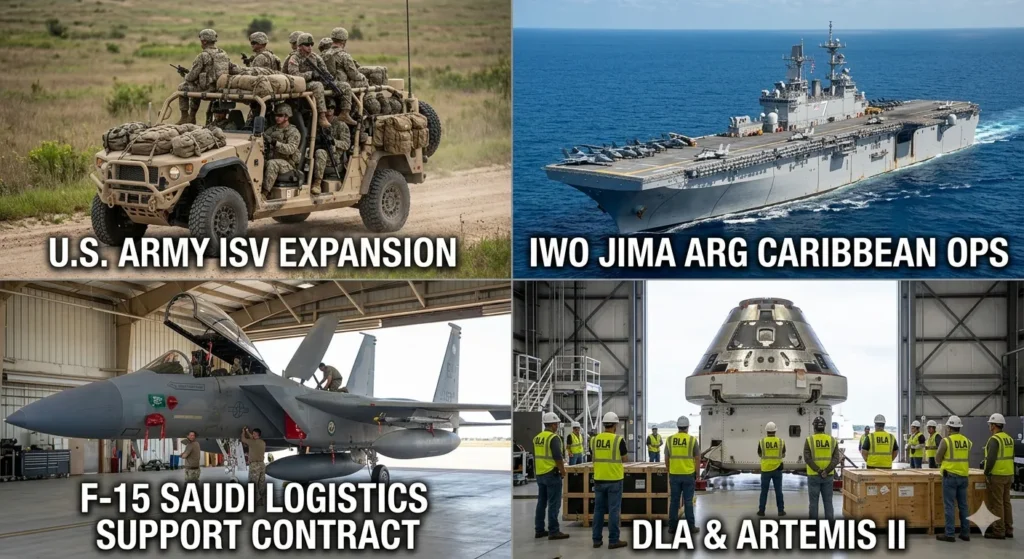
The U.S. Army announced in April that it intends to add 606 ISV-Heavy variants to its current fleet of roughly 1,105 Infantry Squad Vehicles, executed through a three-contract acquisition effort. The new variant is heavier, hybrid-powered, and designed to carry more equipment, more protection, and more onboard electronics.
The shift reflects a broader Army recognition: light tactical mobility is essential, but light alone is not enough in environments where electronic warfare, drones, and indirect fire are pervasive. Hybrid drivetrains also support silent watch, reduced fuel logistics, and electrical power generation for sensors and battle-management systems — all of which compound to reduce the overall transportation burden.
Reference: Defense News Digest: April 2026 Update — IDGA
4. Iwo Jima Amphibious Ready Group Operates in the Caribbean
April 2026 saw the Iwo Jima Amphibious Ready Group operating actively in the Caribbean Sea. The group includes USS Iwo Jima (LHD-7), USS Fort Lauderdale (LPD-28), and USS San Antonio (LPD-17), accompanied by the 22nd Marine Expeditionary Unit.
The amphibious ready group is, in effect, a self-contained transportation node — capable of moving Marines, vehicles, helicopters, landing craft, and humanitarian supplies anywhere in the operating area. Its visible presence in the Caribbean during April underlines the renewed Western Hemisphere focus of U.S. maritime planners and provides a flexible logistics platform for everything from counter-narcotics operations to disaster response.
Reference: USNI News Fleet and Marine Tracker: April 20, 2026
5. SOUTHCOM Establishes a New Autonomous Warfare Command
U.S. Southern Command (SOUTHCOM) stood up the SOUTHCOM Autonomous Warfare Command (SAWC) in April 2026 to accelerate the integration of drones, autonomous surface vessels, and AI-enabled systems across its area of responsibility. SAWC will coordinate closely with the Pentagon’s Defense Autonomous Warfare Group, which has a proposed fiscal 2027 budget of $54.6 billion.
The transportation implications are substantial. Autonomous platforms compress traditional logistics requirements — fewer crews to feed, fewer berthings to maintain, smaller fuel footprints — while also creating new ones, like specialized recovery, charging, and data-link infrastructure. April’s announcement signals that autonomous logistics is no longer a research line item but a fielded capability.
Reference: Defense News Digest: April 2026 Update — IDGA
6. Boeing Wins F-15 Saudi Logistics Support Contract Modification
Boeing was awarded a $37.8 million contract modification in April for contractor logistics support of the F-15 Saudi advanced aircrew training device program. The award brings the cumulative contract value to approximately $144.3 million.
While modest in dollar terms, the contract is a useful reminder that defense transportation is not only about ships, trucks, and aircraft — it is also about the global supply of spare parts, simulators, and training infrastructure that keeps allied air forces operationally ready. Sustained contractor logistics support is one of the most reliable indicators of a long-term defense partnership.
Reference: Contracts for May 1, 2026 — GlobalSecurity.org
7. Defense Logistics Agency Energy Fuels Artemis II
The Defense Logistics Agency Energy played a critical role in NASA’s Artemis II mission in April 2026, supplying more than 21,000 pounds of specialized propellants that enabled the Orion spacecraft to carry astronauts on the program’s first crewed lunar mission.
This crossover between defense transportation logistics and civil space exploration is increasingly common. DLA Energy’s specialized fuels supply chain — built originally for fighter aircraft, naval vessels, and ground vehicles — has become a foundational piece of national-level launch capability, demonstrating how defense logistics infrastructure now underwrites broader strategic ambitions.
Reference: All DLA News – Year 2026 — Defense Logistics Agency
8. UNIFIL Logistics Convoy Blocked in Southern Lebanon
In a stark reminder of how vulnerable peacekeeping logistics can be, a UN Interim Force in Lebanon (UNIFIL) convoy was blocked on a road south of Bayyadah in early April 2026. Israeli Defense Forces personnel reportedly fired warning shots, forcing the convoy to return to base.
The incident underscores a recurring theme of 2026 defense transportation: the “last mile” in conflict zones is often the hardest, and even clearly marked humanitarian or peacekeeping movements cannot be assumed to enjoy safe passage. For multinational logistics planners, redundancy, deconfliction protocols, and political coordination are now as important as fuel and trucks.
Reference: 7 April 2026 – Daily Press Briefing by the UN Spokesperson
9. Naval Aviation: F/A-XX Sixth-Generation Fighter Decision Approaches
April 2026 also brought movement on the U.S. Navy’s sixth-generation F/A-XX fighter program. The Navy is preparing to downselect the prime contractor in August, with the competition narrowed to Boeing and Northrop Grumman following Lockheed Martin’s earlier elimination from the program.
The program will reshape carrier aviation logistics for decades. A new airframe drives new spare-parts pipelines, new training systems, new munitions integration, and new shipboard handling procedures — every one of which is a defense transportation problem in its own right.
Reference: Defense News Digest: April 2026 Update — IDGA
10. The Bigger Picture: What April 2026 Tells Us
Pulling these developments together, several themes stand out.
Logistics is becoming a deterrent. NATO’s Brussels meeting and TRANSCOM’s adaptive posture both signal that the ability to move forces faster, further, and more reliably than an adversary is itself a form of deterrence. Autonomy is moving from labs to commands. SOUTHCOM’s new SAWC and the Pentagon’s $54.6 billion FY2027 autonomous warfare budget show that unmanned platforms now have institutional homes, not just research budgets. Mobility platforms are getting heavier, smarter, and hybrid. The U.S. Army’s ISV-Heavy decision is part of a broader reset of light tactical vehicles for a contested electromagnetic environment. Sustainment partnerships continue to anchor alliances. From the F-15 Saudi training contract to NATO’s Host Nation Support discussions, contractor logistics and host-nation arrangements remain the connective tissue of modern coalitions. Civil-military logistics overlap is growing. DLA Energy’s role in Artemis II is one example among many of how defense transportation infrastructure underwrites national strategic projects beyond traditional warfighting.
For procurement officers, defense industry analysts, and policy planners, April 2026 is a useful snapshot of where the global defense transportation enterprise is headed: more contested, more autonomous, more data-driven, and more central to national strategy than ever before.
Summary
April 2026 reinforced that defense transportation is no longer a back-office function — it is a frontline strategic capability. NATO is hardening collective logistics readiness, U.S. TRANSCOM is institutionalizing AI-enabled visibility, the Army is reshaping its tactical mobility fleet, SOUTHCOM is building autonomous warfare into its command structure, and partners from Riyadh to Brussels are tightening sustainment ties. Expect these themes to define the rest of 2026 and shape acquisition priorities into FY2027 and beyond.