
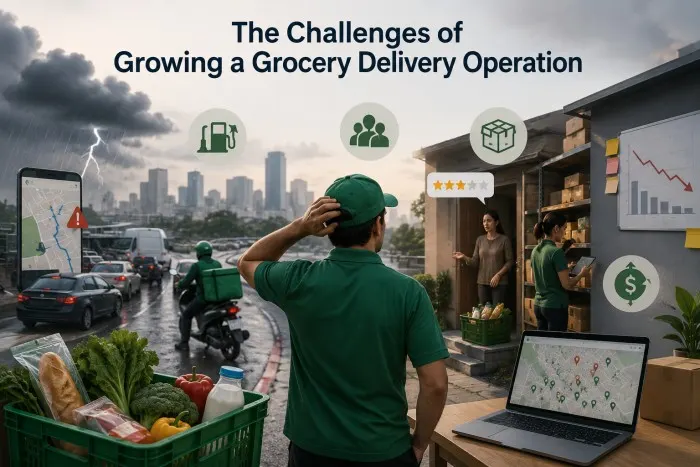
When Growth Starts to Create Friction
At the beginning, grocery delivery feels manageable. A business handles 20 or 30 orders a day, a few drivers cover the routes, and planning can be done manually without much strain. Routes are simple, communication is direct, and problems are relatively easy to fix.
As demand increases, that simplicity disappears. More orders come in, delivery windows overlap, and routes become denser. What once worked smoothly starts to break down. Delays become more frequent, planning takes longer, and coordination becomes harder.
The key challenge is often misunderstood. Scaling grocery delivery is not just about adding more drivers or vehicles. It is about maintaining route efficiency as volume increases.
Why Complexity Grows So Quickly
As order volume rises, each route becomes more packed. Drivers are expected to complete more stops within the same timeframe, often in tightly clustered areas. While this may seem efficient, it actually increases the difficulty of planning.
Delivery windows also become more restrictive. With more customers, there are more overlapping time constraints. A delay at one stop can quickly affect several others.
Coordination becomes another major factor. Dispatchers, drivers, and systems all need to stay aligned. Without structured processes, communication gaps start to appear.
At the same time, customer expectations do not change. If anything, they increase. People expect the same level of reliability regardless of how large the operation becomes.
Where Manual Planning Breaks Down
Manual route planning works at a small scale, but it does not hold up as operations grow.
What feels manageable at 20 stops becomes difficult at 50 and nearly impossible at 100. Sequencing deliveries by hand leads to inefficiencies, even for experienced dispatchers.
Planning also takes more time. As complexity increases, dispatchers spend longer organizing routes, often under pressure. This leads to inconsistent results and a higher risk of mistakes.
Small inefficiencies that were once negligible start to scale. A few extra minutes per stop can turn into hours of delay across multiple routes. Over time, this impacts both performance and cost.
Common Issues That Appear During Growth
As grocery delivery operations expand, several patterns begin to emerge.
Late deliveries become more frequent. With more stops per route, there are more opportunities for delays to occur.
Routes often become unbalanced. Some drivers are overloaded with dense schedules, while others have lighter workloads. This imbalance affects both efficiency and morale.
Visibility becomes limited. Tracking performance across multiple drivers and routes becomes difficult without centralized systems.
Fleet usage also suffers. Vehicles and drivers are not always used in the most efficient way, leading to wasted capacity.
Why On-Time Delivery Gets Harder
Maintaining consistent timing becomes significantly more difficult at scale.
Delays tend to cascade. One late stop affects the next, and the entire route can fall behind schedule. The more stops involved, the stronger this effect becomes.
Accurate ETAs are harder to calculate manually. Without reliable time estimates, both planning and execution suffer.
Drivers are often forced to make decisions on the road. Instead of following a clear plan, they improvise based on current conditions. While this can help in the moment, it usually leads to inconsistent results.
What Scalable Operations Do Differently
To handle growing demand, grocery delivery operations need structured systems rather than ad hoc processes.
Automated route optimization becomes a core requirement. Routes must be generated quickly and based on real-world constraints such as distance, traffic, and delivery windows.
Handling high stop volumes is essential. Whether a route includes 30 stops or 150, the system should maintain efficiency.
Accurate ETAs play a critical role. They support both internal planning and customer communication, reducing uncertainty across the process.
Centralized planning is equally important. Dispatchers need full visibility over all routes to manage operations effectively.
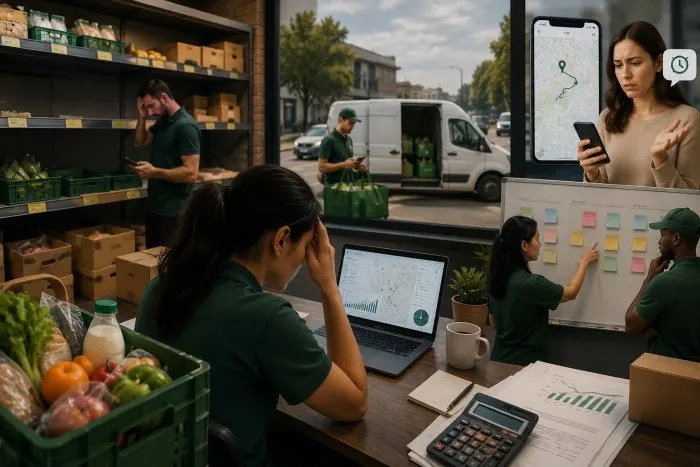
How Businesses Manage Route Complexity
As delivery volumes increase, many businesses move away from manual planning and adopt more structured approaches.
Transitioning to automated systems allows routes to be planned faster and with greater consistency. This reduces the burden on dispatchers and improves overall performance.
Standardizing workflows also helps. When teams follow consistent processes, coordination becomes easier and errors decrease.
Many companies turn to dedicated tools to support this transition. A Grocery Delivery Route Planner App for On-Time Drop-Offs can organize large numbers of stops, generate efficient routes, and provide accurate ETAs.
For example, solutions like Optiway enable teams to plan routes with up to 200 stops in seconds while still allowing drivers to navigate using familiar tools such as Google Maps, Apple Maps, or Waze. This combination helps maintain efficiency without disrupting daily workflows.
Practical Ways to Scale Without Losing Control
Scaling successfully requires a shift in how routes are planned and managed.
Planning should be centralized rather than left to individual drivers. This ensures consistency and better oversight.
Routes need to be optimized daily. Delivery volumes, traffic, and conditions change constantly, so static planning is not enough.
Workloads should be balanced across drivers to prevent overload and improve overall efficiency.
Performance metrics must be monitored regularly. Data helps identify bottlenecks and areas for improvement.
- Track delivery times and delays
- Compare planned vs actual routes
- Adjust delivery zones based on demand
- Refine scheduling based on real conditions
What Efficient Scaling Makes Possible
When route planning is structured and scalable, several benefits become clear.
On-time delivery becomes more consistent, even as volume increases. This strengthens customer trust and improves retention.
Delivery capacity grows without requiring a proportional increase in costs. More stops can be completed within the same timeframe.
Operational stress decreases. Drivers follow clearer routes, and dispatchers spend less time managing issues.
Customer satisfaction improves as reliability increases. Consistency becomes a defining strength rather than a challenge.
Final Perspective
Growth in grocery delivery brings more than just higher order volumes. It introduces complexity that cannot be managed with the same methods used at a smaller scale.
Manual processes eventually reach their limits. Without changes in how routes are planned and executed, inefficiencies begin to dominate operations.
Businesses that invest in scalable planning systems, including tools like a https://optiway.io/industries/optimize-grocery-and-food-delivery-routes-with-accurate-etas/ , are better equipped to grow while maintaining efficiency and service quality.