
The Logistics Behind Moving Heavy Iron
Moving heavy construction equipment from one job site to another is rarely as straightforward as loading a machine onto a flatbed and hitting the highway. Whether you’re relocating a fleet of excavators across state lines or shipping a single crane to a remote infrastructure project, the logistics involved demand precision, regulatory knowledge, and the right carrier partnerships. For project managers and fleet operators, understanding how construction equipment transport actually works — from permitting to route surveys — can mean the difference between a project that starts on time and one that stalls before the first shovel breaks ground.
Why Standard Freight Carriers Fall Short
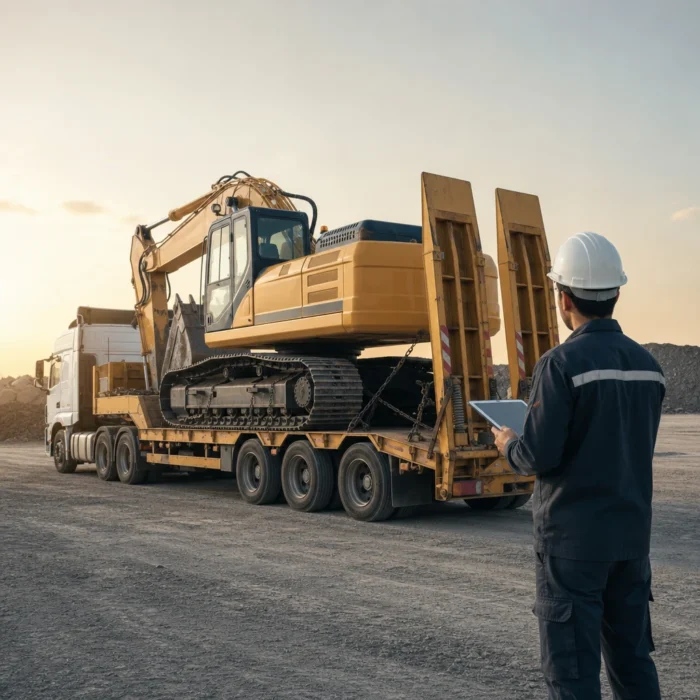
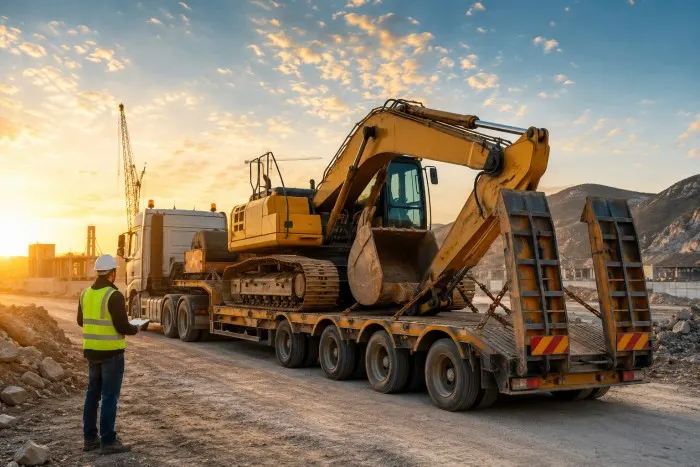
Many companies make the mistake of treating heavy equipment like oversized freight. In reality, construction machinery — bulldozers, motor graders, skid steers, compactors, and articulated dump trucks — presents a unique set of challenges that standard freight carriers are simply not equipped to handle. These machines are often non-running, irregularly shaped, and far heavier than what a conventional dry van or even a standard flatbed can legally or safely accommodate. Specialized lowboy trailers, step-deck configurations, and multi-axle platforms are frequently required just to get the load off the ground legally. Beyond the equipment itself, carriers must account for weight distribution, tie-down engineering, and the structural integrity of the trailer under dynamic road conditions.
Permitting and Regulatory Compliance: The Hidden Complexity
One of the most underestimated aspects of heavy equipment transport is the permitting process. Every state has its own rules governing oversize and overweight loads, and those rules don’t always align neatly at state borders. A single cross-country haul might require permits from six or more jurisdictions, each with different dimensional thresholds, travel time restrictions, and escort vehicle requirements. Some states prohibit oversize loads from traveling on weekends or holidays. Others mandate pilot cars at the front and rear of the convoy, along with certified route surveys to confirm that bridges, overpasses, and underpasses can handle the load. Failing to secure the correct permits doesn’t just result in fines — it can halt a shipment entirely, leaving expensive equipment stranded on the side of a highway.
Route Planning and Site Accessibility
Route planning for heavy equipment transport goes well beyond plugging an address into a GPS. Experienced road transport coordinators conduct detailed route analyses that account for bridge weight ratings, road surface conditions, overhead utility lines, tight turns, and low-clearance structures. In urban environments, this can require coordination with local municipalities to temporarily close lanes or reroute traffic. In rural settings, unpaved access roads leading to construction sites may need to be assessed for load-bearing capacity before a lowboy can even attempt delivery. The more remote or complex the destination, the more critical this pre-transport planning becomes. Skipping this step is one of the most common — and costly — mistakes in the industry.
Global Supply Chain Pressures and Equipment Availability
The construction equipment transport sector doesn’t operate in isolation. It is deeply affected by broader supply chain dynamics, geopolitical developments, and shifts in global logistics infrastructure. For example, recent reporting has highlighted how airspace restrictions and international transit disputes can delay the delivery of critical heavy machinery, even when the equipment itself is ready to ship. While that particular case involves military aviation assets, the underlying principle applies across industries: when transit corridors are disrupted — whether by political decisions, infrastructure failures, or regulatory bottlenecks — the ripple effects reach construction sites, infrastructure projects, and equipment fleets around the world. Domestic transport providers who understand these macro-level pressures are better positioned to offer contingency planning and alternative routing strategies.
Insurance, Liability, and Risk Management
Heavy construction equipment represents a significant capital investment, and protecting that investment during transport requires more than a standard cargo insurance policy. Specialized equipment transport carriers typically carry higher liability limits and offer cargo coverage tailored to the replacement value of the machines being hauled. Project managers should always verify a carrier’s insurance certificates before signing a transport agreement, and they should understand exactly what is and isn’t covered in the event of damage, theft, or an accident during transit. Equipment that is improperly secured, loaded by unqualified personnel, or transported without the correct permits may fall outside the scope of standard coverage — a detail that can have devastating financial consequences.
Choosing the Right Transport Partner
Not all heavy haul carriers are created equal. When evaluating transport providers, construction companies and fleet managers should look beyond price and focus on experience, equipment inventory, safety records, and the depth of their permitting expertise. A carrier that specializes in construction equipment will have established relationships with permit agencies across multiple states, a fleet of properly maintained lowboys and step-decks, and drivers who are trained specifically in the loading and securing of heavy machinery. References from past clients, particularly those in similar industries or with comparable equipment types, are invaluable in the vetting process. The cheapest quote rarely reflects the true cost of a transport gone wrong.
Bear Down Logistics: Built for Heavy Haul
Bear Down Logistics has built its reputation on delivering reliable, compliant, and professionally managed heavy equipment transport solutions for construction companies across the country. With a team that understands the nuances of oversize permitting, route planning, and equipment handling, Bear Down operates as a true logistics partner rather than just a carrier. Their approach prioritizes communication, transparency, and on-time delivery — qualities that matter enormously when a delayed machine can hold up an entire project timeline. For companies that need a dependable partner to move their most valuable assets, Bear Down Logistics brings the expertise and infrastructure to get the job done right.
Industry Standards and the Road Ahead
The trucking and heavy haul industry continues to evolve, driven by advances in trailer technology, electronic logging mandates, and shifting infrastructure investment across the country. Organizations like the American Trucking Associations play a critical role in shaping federal policy, advocating for infrastructure funding, and setting safety standards that directly affect how heavy equipment is transported on public roads. Staying informed about regulatory changes — from hours-of-service rules to bridge formula updates — is essential for any company that relies on ground transport to move its construction fleet.
Transport as a Strategic Asset
For construction companies operating across multiple job sites, equipment transport is not a peripheral concern — it is a core operational function. The ability to move machinery efficiently, safely, and in full regulatory compliance directly affects project timelines, budget performance, and client satisfaction. Partnering with experienced construction equipment transport services is one of the most impactful decisions a project manager can make. When the right carrier is in place, equipment arrives on schedule, crews stay productive, and projects move forward without the costly delays that come from logistics failures. In an industry where time is money and machinery is capital, getting transport right is not optional — it’s essential.