
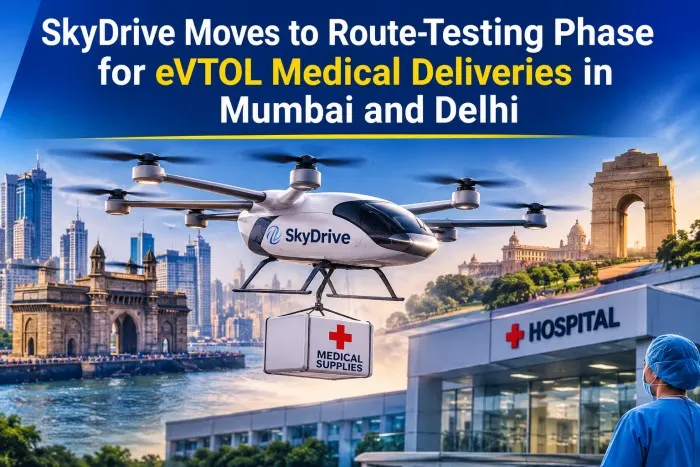
Japan’s SkyDrive Inc. has pushed its India air-logistics partnership with Air India and Suzuki Motor Corporation into a new stage, identifying the specific corridors it wants to test for delivering time-sensitive medical cargo by electric aircraft. The update, announced August 25, 2026, builds on a Memorandum of Understanding the three companies signed on July 31, 2026, to jointly examine whether electric vertical take-off and landing (eVTOL) aircraft can solve one of urban India’s most persistent logistics headaches: getting critical shipments across cities fast enough to matter.
Why Road Traffic Is the Real Target
The rationale behind the project has little to do with futuristic transport for its own sake. India’s biggest metros have absorbed population and vehicle growth faster than their road networks can handle, and that congestion routinely eats into the narrow time windows available for moving organs, radioactive isotopes used in diagnostics, and other perishable medical materials. An ambulance run that should take a few minutes can stretch past an hour once it hits gridlock, which is exactly the kind of delay that determines outcomes in transplant medicine and emergency care.
SkyDrive’s evaluation now centers on three candidate use cases:
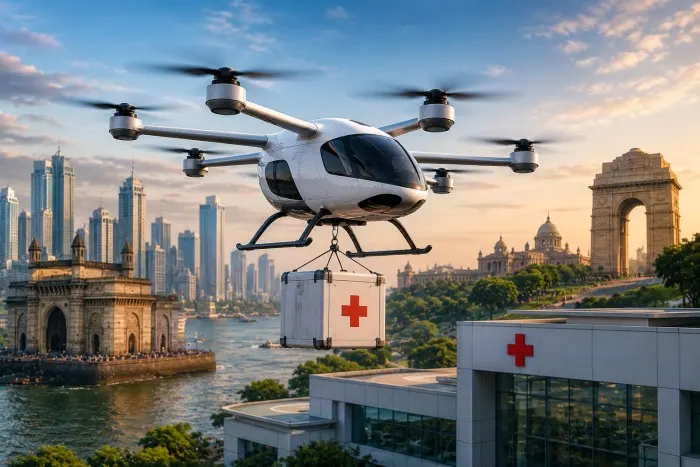
- Mumbai manufacturing-to-hospital transport — moving medical supplies from a production site to nearby major hospitals, testing whether short-hop air delivery can prevent degradation of temperature- or time-sensitive materials.
- Delhi NCR inter-hospital transfers — a corridor connecting major hospitals across the National Capital Region, where the study aims to compress transfer times that currently run 30 to 90 minutes by road down to roughly 10 to 15 minutes by air.
- Airport parts logistics near Delhi’s Indira Gandhi International Airport — a route linking parts-collection hubs and maintenance bases to airport terminals, addressing Aircraft on Ground (AOG) situations caused when traffic delays hold up replacement components during maintenance.
That last item marks an expansion of the project’s original scope. SkyDrive says that while mapping medical delivery routes, it became clear that the same congestion problem was stalling aircraft maintenance logistics, prompting the team to fold parts delivery into the feasibility work alongside the medical use cases.
Three Companies, Three Roles
The arrangement splits responsibilities along each partner’s core strength. SkyDrive supplies the aircraft technology and route-design expertise; Air India contributes cargo operations experience, airport infrastructure knowledge and its existing stakeholder relationships within India’s aviation sector; and Suzuki brings decades of experience building compact, efficient vehicles engineered for Indian road and climate conditions. SkyDrive, founded in 2018 after beginning prototype testing in 2014, became the first company to fly a piloted eVTOL in Japan in 2019 and has positioned itself around what it calls a once-in-a-century shift in mobility.
Any actual flight operations remain contingent on sign-off from India’s aviation authorities — nothing in this phase authorizes real-world eVTOL flights yet. India’s civil aviation regulator has already laid some regulatory groundwork for exactly this kind of aircraft: the Directorate General of Civil Aviation issued national guidelines for vertiport design and operations, covering the infrastructure standards vertical take-off and landing facilities would need to meet before eVTOL services like this one could legally operate.
What Comes Next
SkyDrive says the three partners plan to keep expanding the feasibility study through further engagement with stakeholders, including regulators, hospital systems and airport operators, before any pilot deployment is considered. No timeline for actual test flights or commercial rollout has been disclosed. For now, the project remains at the planning and route-mapping stage — a first step toward determining whether India’s medical and aviation logistics networks can realistically absorb a new layer of low-altitude air transport.