
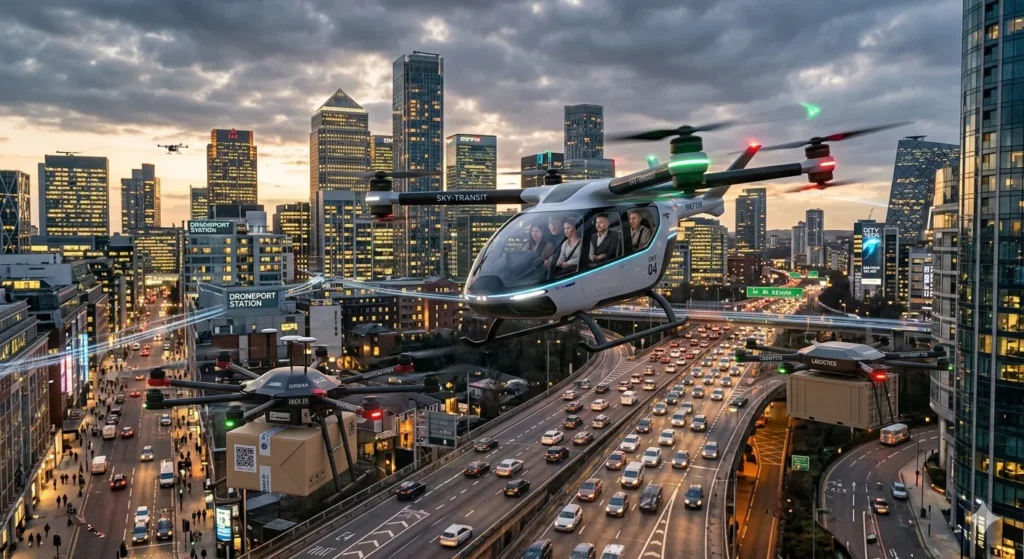
Drone transportation is transitioning from experimental novelty to a practical, scalable component of Europe’s logistics, healthcare, and urban mobility ecosystems. Supported by progressive EU regulations, technological advancements, and urgent needs for faster, greener, and more resilient supply chains, Europe positions itself as a global leader in this space. By 2030, the sector could be worth billions and create tens of thousands of jobs, reshaping how goods—and potentially people—move across the continent.
Regulatory Foundations: EASA and Drone Strategy 2.0 Pave the Way
The European Union Aviation Safety Agency (EASA) has established one of the world’s most advanced frameworks for drone operations. Regulations categorize operations into Open, Specific, and Certified tiers based on risk, enabling Beyond Visual Line of Sight (BVLOS) flights crucial for commercial delivery and cargo. U-space services facilitate safe integration into airspace, supporting dense urban operations.
The European Commission’s Drone Strategy 2.0 (2022) outlines a vision with 19 flagship actions for a competitive drone market, sustainable growth, and synergies between civil, security, and defense uses. This includes support for Urban Air Mobility (UAM) with eVTOLs for passengers and cargo. Complementary initiatives address security and counter-drone measures.
These rules provide stability and confidence for investment, distinguishing Europe from more fragmented markets elsewhere.
Successful Operations: Real-World Deployments Delivering Today
Several projects have moved beyond trials into regular or scaled operations:
- Manna Drone Delivery (Ireland): One of Europe’s standout successes. The Irish company has completed over 250,000 deliveries (with strong growth in 2025), operating in multiple locations including Dublin suburbs like Blanchardstown and Balbriggan. It delivers food, groceries, pharmaceuticals, and more in under three minutes in many cases. Manna raised $50 million recently and plans expansion, with high community adoption (e.g., 62% household usage in some areas). It also operates in Finland and the US.
- Wing (Alphabet): Expanded into Europe with operations in Finland (Helsinki area, thousands of deliveries monthly) and trials/demonstrations in Ireland and elsewhere. Wing has accumulated hundreds of thousands of deliveries globally, emphasizing safety and speed (fastest under 3 minutes). It partners for medical and retail deliveries.
- Port and Industrial Logistics: Drones transport samples and parts efficiently in controlled environments. The Port of Antwerp uses drones for petrochemical samples; similar explorations occur in Hamburg and Rotterdam. These settings minimize regulatory hurdles and demonstrate reliability in commercial settings.
- Medical Deliveries: Projects like Unifly-powered trials in Belgium (AZ Turnhout hospitals) deliver supplies between campuses. These highlight life-saving potential in time-critical scenarios.
Earlier pioneers like DHL’s Parcelcopter demonstrated regular medical deliveries to remote islands (e.g., Juist, Germany) in the 2010s, proving the concept even if the specific program evolved or paused.
Pipeline Projects Nearing Completion or Scale
Several high-potential initiatives are in advanced testing or on the cusp of broader commercial rollout:
- Dronamics and the Black Swan: Europe’s first licensed cargo drone airline (Bulgaria-based). The Black Swan is a fixed-wing drone carrying up to 350 kg over 2,500 km—ideal for regional and island logistics, pharma, perishables, and e-commerce. It completed its first full-scale flight in 2023, reached 500 flights by late 2025, and plans commercial cargo operations. It promises up to 50% lower costs and 60% lower CO₂ than traditional air freight. Networks of “droneports” are in planning/operation across multiple countries. Dual-use (civil/defense) applications add resilience.
- Other Cargo and Middle-Mile Trials: Windracers Ultra trials in Orkney (Scotland) for inter-island cargo. Trials at Malpensa Airport (Italy) and various “middle-mile” logistics tests. Grasshopper Air Mobility and others advance autonomous cargo for logistics 4.0.
- Urban Air Mobility (UAM) and eVTOLs: Regulatory building blocks are in place for passenger and heavy cargo operations. Pilot programs and corridors (e.g., in France) test integration. Passenger drones are expected to grow rapidly for short-range mobility.
- Rural and Remote Focus: Drones address challenges in islands (e.g., Greek plans), mountains, and sparsely populated areas where roads are inefficient.
Benefits and Transformative Potential
Drone transportation offers faster deliveries (minutes vs. hours/days), lower emissions (especially electric models), reduced road congestion, and access to hard-to-reach areas. In logistics, it complements trucks for last-mile or middle-mile, cutting costs in suitable scenarios. Healthcare gains from rapid transport of samples, medicines, or organs. During disruptions (e.g., weather, infrastructure failures), drones provide resilience.
Market projections are optimistic: Europe’s drone market (broader UAV) is expected to grow significantly, with logistics segments expanding rapidly. Rural expansion and integration with e-commerce platforms are key opportunities.
Challenges on the Horizon
- Airspace Integration and Scalability: Managing high volumes with manned aviation requires robust U-space/UTM systems.
- Public Acceptance and Privacy: Noise, safety perceptions, and data concerns need addressing through engagement.
- Infrastructure: Vertiports, charging, and maintenance networks require investment.
- Economics and Weather: Battery/range limits, costs for heavy payloads, and operations in varied European weather.
- Security: Counter-drone measures are advancing alongside growth.
Outlook: A Connected, Sustainable European Sky
By the mid-2030s, Europe’s skies could be significantly busier with drones handling deliveries, inspections, agriculture, and UAM. The combination of regulatory leadership, innovative companies (many European-headquartered), and EU funding creates a strong foundation. Initiatives like Dronamics’ network, Manna’s scaled operations, and Wing’s expansions show momentum.
Drone transportation will not replace all traditional methods but will augment them—making logistics smarter, greener, and more equitable. For Europe, it represents not just technological progress but strategic autonomy in a critical future industry.
As these systems mature, the question shifts from “if” to “how quickly” drone transportation becomes everyday infrastructure. The foundation is built; the ascent is underway.
What are your thoughts on drone deliveries in your city or region? Share in the comments.